【2026 Complete Guide】VOO Sub-brokerage Beginner's Guide: From Opening an Account to Completing Your First Trade and Buying US Stock ETFs
In this article, you'll learn:
Introduction: Is Investing Difficult? Maybe Being “Lazy” Is Better
Many people think that investing and financial management is a profound subject, full of complex charts and terms that make people daunting. But to be honest, if you want to grow your wealth steadily through investment, you don’t have to stare at the market every day and study financial reports.
Sometimes, being “lazy” is the most efficient strategy.
In this article, I will share my personal experience and take you from scratch, step by step, to complete the “sub-brokerage” account opening at a Taiwanese brokerage, and buy your first US stock ETF - VOO. This is the starting point that I think is most suitable for beginners, so that your wealth path can start steadily in the most worry-free way. 🚀
Info
💡 Want to learn more about VOO investing? Visit the VOO 投資知識中心 (VOO Investing Knowledge Center), which brings together all VOO-related investment tutorials and strategy analysis!

Why Did I Choose VOO Later?
VOO (Vanguard S&P 500 ETF) is an ETF that tracks the US S&P 500 index. Simply put, buying one share of VOO is equivalent to buying stocks of the top 500 US companies at once, including tech giants such as Apple, Microsoft, NVIDIA, Amazon, and Google. VOO is one of the most popular US stock ETFs in the world and is also Buffett’s preferred choice for general investors.
If you are not very clear about the differences between popular ETFs such as VOO, QQQ, and VT, it is recommended to read this article first: VOO、QQQ、VT怎麼選?10大熱門ETF投資指南, after understanding the characteristics of different ETFs, you will be clearer about why VOO is suitable for most investors.
Honestly, I initially invested in the more volatile QQQ (Nasdaq 100 Index ETF). But as I became clearer about my financial goals, I found that VOO was more in line with the needs of long-term investment - pursuing stable annualized returns rather than short-term high volatility. VOO’s annualized rate of return has historically averaged around 10-12%, which is a very suitable target for long-term holding.
The Four Major Investment Advantages of VOO ETF:
✅ Diversified Enough: Investing in 500 leading companies at a time, putting eggs in many good baskets, naturally reduces risk.
✅ Low Cost: The expense ratio is only 0.03%, which means that for every NT$10,000 (USD $300) invested, only NT$3 (USD $0.1) of management fee is charged per year, which is extremely low cost.
✅ Stable Performance: In the long run, the annualized rate of return of the S&P 500 index is about 10-12%, which is a very reliable performance indicator.
✅ Easy to Buy and Sell: The trading volume is very large, you can buy it whenever you want, and you can sell it whenever you want.
Sub-brokerage vs. Overseas Brokerage? I’m “Too Lazy” to Choose Sub-brokerage
Before buying US stocks, the biggest entanglement point for novices must be: “Should I use an overseas brokerage or a sub-brokerage?”
The Internet is full of comparisons about handling fees, and many people will say that overseas brokerages have lower handling fees. Yes, that’s true. But after a round of research, I finally chose sub-brokerage because of “laziness” and a more important consideration.
For a more detailed comparison of brokerages and fee analysis, please refer to: 2026複委託券商推薦:永豐、富邦、國泰手續費大PK.
Complete Comparison Table of Sub-brokerage and Overseas Brokerage:
Step-by-Step: My Practical Experience of Opening an Account with SinoPac Securities Sub-brokerage
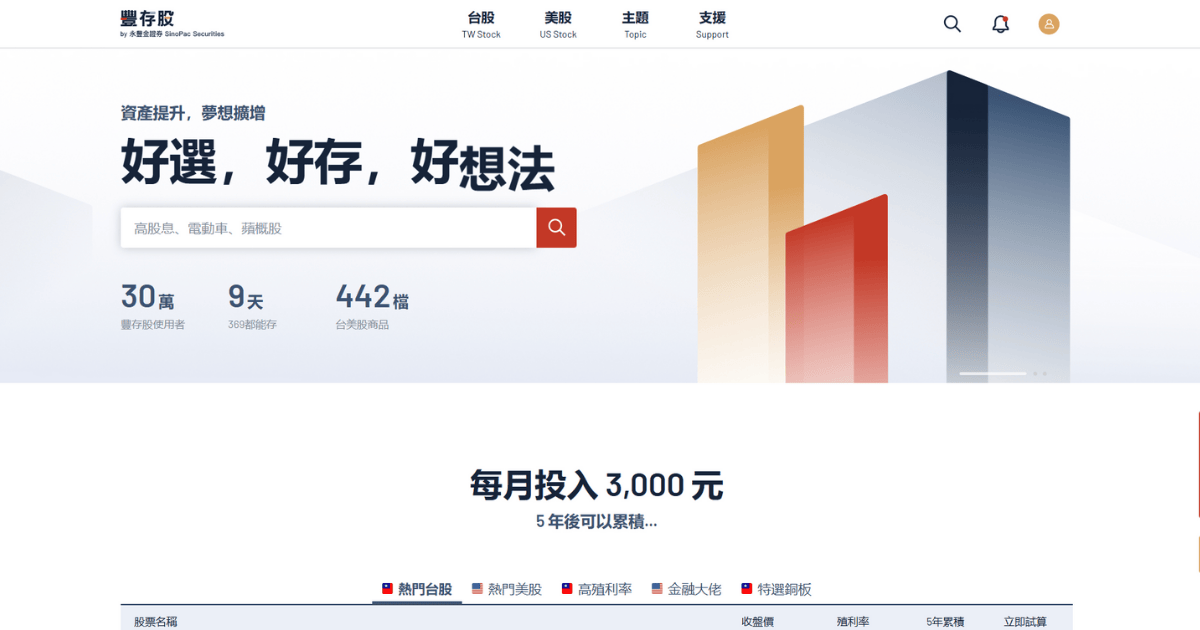
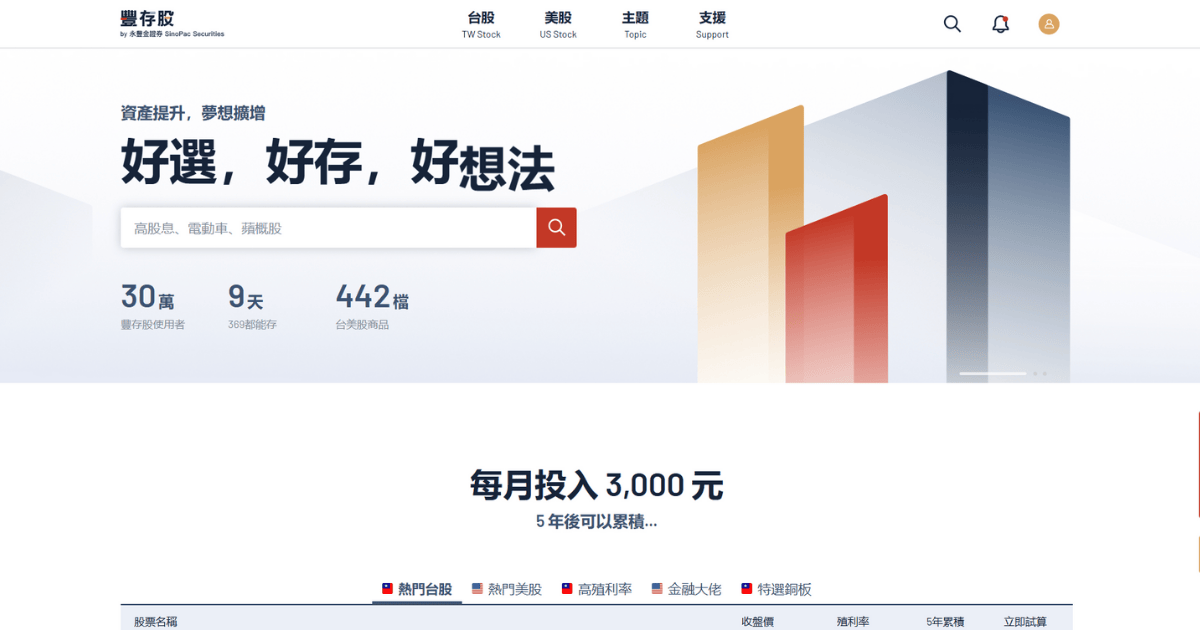
I am a long-term customer of SinoPac Bank, and my salary transfer account is also here. In order to implement the “lazy spirit”, I hope that my salary can be directly deducted for investment as soon as it comes in, so I naturally chose SinoPac Securities’ “豐存股” service. Your choice may be different, but the account opening process is similar:
Tip
開戶連結 (Account opening link) If you need to know more, I can recommend my salesperson to you for reference.
Detailed Explanation of the Three Steps of Sub-brokerage Account Opening
Step 1: Preparation Before Opening an Account
Investment Budget Planning:
- Single investment: It is recommended to prepare at least USD $100 (about NT$3,000)
- Dollar-cost averaging: At least NT$3,000 per month, you can buy fractional shares of VOO
Required Document List:
- Original of ID card
- Second document (National Health Insurance (健保) card or driver’s license)
- Chop
- Bank passbook for agreed deduction (it is recommended to use the salary transfer account)
Step 2: Account Opening Process (Taking SinoPac as an Example)
Online Appointment for Account Opening
- Go to the SinoPac Securities website
- Click “Appointment for Account Opening”
- Fill in basic information
- Important: Remember to check the “US Stock Sub-brokerage” service
In-person Processing (About 30-40 Minutes)
- Bring all required documents
- Go to the reserved SinoPac Securities branch
- The teller will assist you in completing all the procedures
Fill in the W-8BEN Form (Important)
- This is a tax form from the US Internal Revenue Service
- Prove that you are a non-US tax resident
- The withholding tax on dividends is reduced from 30% to 15%
- Valid for 3 years, need to be updated regularly
Download the SinoPac Securities APP
- App name: “SinoPac Securities”
- Complete identity verification
- Activate the US stock sub-brokerage trading authority
Step 3: Funding and Currency Exchange
Best Time to Exchange Currency:
- Taiwan time 9:30-11:00 (better interbank exchange rate)
- Avoid Friday afternoons (exchange rate is usually worse)
- Exchange currency in batches when the US dollar weakens
Comparison of Three Funding Methods:
- NTD Deduction (Recommended for Beginners)
- Advantages: The most convenient, the brokerage automatically exchanges currency
- Disadvantages: The exchange rate is slightly worse by NT$0.03-0.05
Execute Your First VOO Trade
- Dollar-Cost Averaging (Most Recommended)
- Automatically deduct money to invest in VOO
- Dollar-cost averaging reduces risk
- Suitable for long-term investment
How to Place an Order to Buy VOO: Practical Operation Tutorial
US Stock Trading Time Comparison Table:
What After Buying? My “Lazy” Follow-up Strategy
Detailed Explanation of VOO Order Placement Steps:
Log in to the SinoPac Securities APP
- Log in using a certificate or biometric identification
- Select the “US Stock Sub-brokerage” function
Search for VOO
- Enter “VOO” in the search bar
- Confirm that it is “Vanguard S&P 500 ETF”
- Check the current price (about USD $450-500/share)
Choose a Buying Method
- Click the “Buy” button
- Choose “Whole Shares” or “Fractional Shares”
Enter the Purchase Quantity
- Whole Shares: Buy at least 1 share
- Fractional Shares: You can buy from 0.001 shares (about USD $1.5)
Choose an Order Type
- Market Order: Execute immediately at the market price (recommended for beginners)
- Limit Order: Set the expected purchase price
- Dollar-Cost Averaging: Automatically buy on a fixed date every month
Confirm and Submit the Order
- Check the transaction details
- Confirm the handling fee (usually 0.15-0.5%)
- Click Confirm to submit
Confirmation of Transaction: About 1-2 minutes after the transaction is completed, you can see your VOO holdings on the “Holdings” or “Inventory” page of the APP! Congratulations on officially becoming an investor in the S&P 500 index!
VOO Long-Term Investment Strategy: Dollar-Cost Averaging and Asset Allocation
Three Keys to Success in Investing in VOO:
The most important thing in investing in VOO is not the timing of buying, but the “discipline of long-term holding”. Here are proven effective investment strategies:
Dollar-Cost Averaging
- Set up automatic deductions on a fixed date every month
- Recommended amount: 10-20% of monthly income
- Continue to buy regardless of market ups and downs
- Long-term average cost, reducing the risk of timing
Buy and Hold Strategy
- Target holding period: At least 5-10 years
- VOO historical annualized return: About 10-12%
- Avoid frequent trading, reduce transaction costs
- Allow the effect of compound interest to be fully realized
Asset Allocation Recommendations
- VOO accounts for stock holdings: 60-80%
- Can be matched with bond ETFs (such as BND) to reduce volatility
- Keep 3-6 months of emergency funds
- Continue to increase income from your main job and expand your investment principal
Frequently Asked Questions FAQ: VOO Sub-brokerage Investment Q&A
懶得有結論 (Lazy Conclusion)

Final Recommendations for Investing in VOO Sub-brokerage:
Through the complete tutorial in this article, you have learned how to buy VOO through a Taiwanese brokerage sub-brokerage. This is a simple, safe, and beginner-friendly way to invest in US stocks.
As an S&P 500 index ETF, VOO allows you to invest in the 500 largest companies in the United States at once, and is one of the most popular ETFs in the world. Through dollar-cost averaging, you can:
- 🏦 Diversify risk and avoid the volatility of individual stocks
- 💰 Enjoy the low-cost investment advantage (0.03% expense ratio)
- 📈 Participate in the long-term growth of the US economy
- ⏰ Let time and compound interest work for you
Remember, investing is a marathon, not a sprint. Start your VOO sub-brokerage investment journey now!
🚀 已有 1,000+ 讀者加入理財成長之路
Further Reading
Disclaimer:
This article is for educational purposes only and does not constitute investment advice. Investing involves risk, please carefully assess your own risk tolerance.
想學習更多相關知識?
返回 VOO 投資中心 📚![[2025 Complete Guide] VOO Sub-Brokerage for Beginners: From Opening an Account to Your First U.S. ETF Trade](/images/blog/20250910.png)