2026 Sub-brokerage Recommendation: Yuanta, Cathay, Fubon Fee Comparison (Latest)
- 懶大 (Lan Da)
- 財務工具與金融商品
- Last updated: February 20, 2026
- 5 min read
In this article, you'll learn:
Info
💡 Want to learn more about VOO investment strategies? Visit the VOO Investment Knowledge Center
Introduction: See this 60 seconds before recommending a sub-brokerage
If you have decided to buy a US stock ETF (like VOO), the next question is usually: Which sub-brokerage should I open so that I don’t pay extra fees in vain?
This article directly compares major brokerages using the same standards, allowing you to first select a plan that “best suits your monthly deduction habits” before deciding whether to pursue the lowest rate.
Quick answer: How to choose a sub-brokerage recommendation?
- For small monthly amounts (under $100 USD), first look at fixed low fee plans (Cathay and Capital are usually more friendly).
- Focus on long-term compound interest efficiency, and prioritize DRIP function and ease of operation (Yuanta has a clear advantage).
- Only compare percentage rates and whether there is a minimum consumption if the monthly investment amount is high and not fixed (Fubon and KGI can be evaluated).
- If you have not yet decided on an ETF target, first look at How to choose VOO, QQQ, and VT? and then come back to choose a brokerage, the decision will be faster.
- If you want to start allocating directly, first use the ETF Beginner Allocation Toolkit to calculate the monthly investment amount and ETF ratio.
Why should novices start with “Sub-brokerage”? Understand overseas brokers vs. sub-brokers in seconds
Before buying US stocks, you will definitely hear about “sub-brokerage” and “overseas brokers”. They each have advantages and disadvantages, but I usually recommend novices to start with “sub-brokerage”.
| Feature Comparison | ✅ Sub-brokerage | ❌ Overseas Broker |
|---|---|---|
| Fund Security | Very high (funds are in the country and are supervised by the Financial Supervisory Commission) | Medium (need to bear the risk of overseas brokers going bankrupt) |
| Account opening and operation | Simple (all Chinese interface and customer service) | More complicated (usually an English interface, you need to deal with it yourself) |
| Fund transfer | Convenient (direct debit or transfer in NT$) | Cumbersome (requires international wire transfer, with additional fees and time costs) |
| Estate processing | Simple (handled in accordance with Taiwan regulations) | Extremely complicated (need to deal with US estate tax issues) |
| Handling fee | Higher (but there are many discounts in recent years, and the gap has narrowed) | Lower (some brokers even have zero handling fees) |
Too lazy to have a conclusion

🚀 已有 1,000+ 讀者加入理財成長之路
📚 Back to VOO Investment Knowledge Center
2026 Major Brokerage Sub-brokerage Program PK
To make it clear at a glance, I have compiled the handling fee programs of Yuanta, Fubon, Cathay, Capital, and KGI on US stocks “fixed amount investment” based on the latest research. This is also the part that our lazy investors care about most!
| Brokerage | Fixed amount investment (buy) handling fee | Fixed amount investment (sell) handling fee | Minimum subscription amount | 懶大 (Lan Da) Comments ⭐ |
|---|---|---|---|---|
| Cathay Securities | US stocks/ETFs are all priced at $0.1 USD per transaction (official website plan) | US stock ETFs are $3 USD per transaction (official website plan) | $10 USD | Small capital friendly, clear rules, suitable for people who are just starting fixed amount investment. |
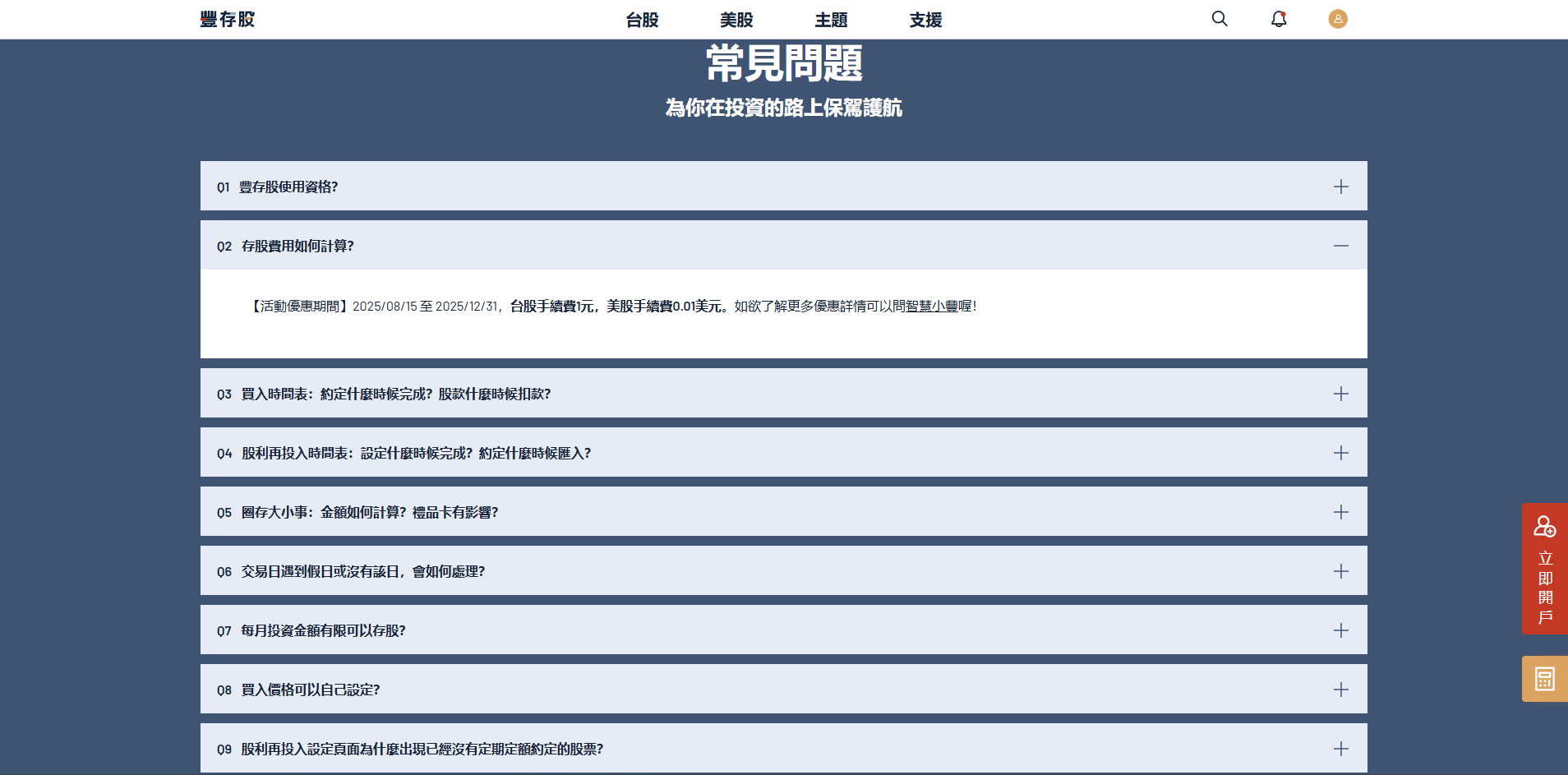
| Yuanta Securities (豐存股 (Feng Cun Gu)) | NT$1 NTD for NTD deduction / $0.01 USD for foreign currency deduction (announced plan) | 0.18% of the selling amount (minimum $3 USD) | $10 USD | Low threshold + high DRIP support, suitable for lazy people to snowball in the long term. |
| Capital Securities | US Stock Savings Pass is $0.03 USD per transaction (activity plan) | Based on general sub-brokerage fee rate | $10 USD | Fixed low handling fee is very competitive, but the activity period must be confirmed. |
| KGI Securities | General sub-brokerage buy-in 0.3% (2025 activity has ended, return to the listed price) | General sub-brokerage sell-out 0.5% (minimum $10 USD) | According to product rules | Suitable for investors who will negotiate rates with business personnel and have higher transaction flexibility. |
| Fubon Securities | The official website focuses on low threshold for fixed amount investment (starting from $10 USD or NT$300 NTD); the fee rate is announced according to the plan | Compared to the general sub-brokerage fee rate (depending on the branch/plan) | $10 USD | If you already have an account in the Fubon system, the integration is high; but be sure to confirm the current activity rate and expiration date before placing an order. |
懶大 (Lan Da)’s sincere words: How should investors with different budgets choose?
Whether you want to invest NT$3,000, NT$10,000 or NT$30,000 per month, I think the most important thing is always “convenience” and “being able to start”.
- If you are an extremely frugal small capital family (less than $100 USD per month): Cathay or Capital’s fixed low handling fee is the most cost-effective.
- If you are an ultimate lazy person and value long-term compound interest: Yuanta’s exclusive “dividend reinvestment” function is irreplaceable.
- If you invest a higher or unfixed amount each month: KGI or Fubon’s “no minimum” percentage billing method may be more suitable for you.
The compound interest magic of dividend reinvestment (DRIP): Why is this the key to lazy investment?
Like Buffett said, life is like a snowball, the important thing is to find wet snow and a long hillside. In investment, “dividends” are the snow that allows you to stick together, and “dividend reinvestment” is to roll this snow back onto your snowball to make it bigger and bigger.
If you spend the dividends you receive, the snowball will never grow. Let’s see how big the difference is in the long run if the dividends are reinvested:
Assumption: A single investment of $10,000 USD in VOO, with an annualized return of 12% and a dividend rate of 1.5%
| Time | Dividend Reinvestment (Total Value) | Dividend Not Reinvested (Total Value) | Difference |
|---|---|---|---|
| 10 years | ~$38,000 | ~$34,000 | ~$4,000 |
| 20 years | ~$128,000 | ~$105,000 | ~$23,000 |
| 30 years | ~$410,000 | ~$310,000 | ~$100,000 |
This is a simplified estimate and does not consider tax factors
See the difference? Over 30 years, a small “dividend reinvestment” action can increase your assets by $100,000 USD! This is why I highly recommend Yuanta’s function.
Step-by-step tutorial: Taking Yuanta Securities as an example, how to set up a fixed amount investment in US stocks
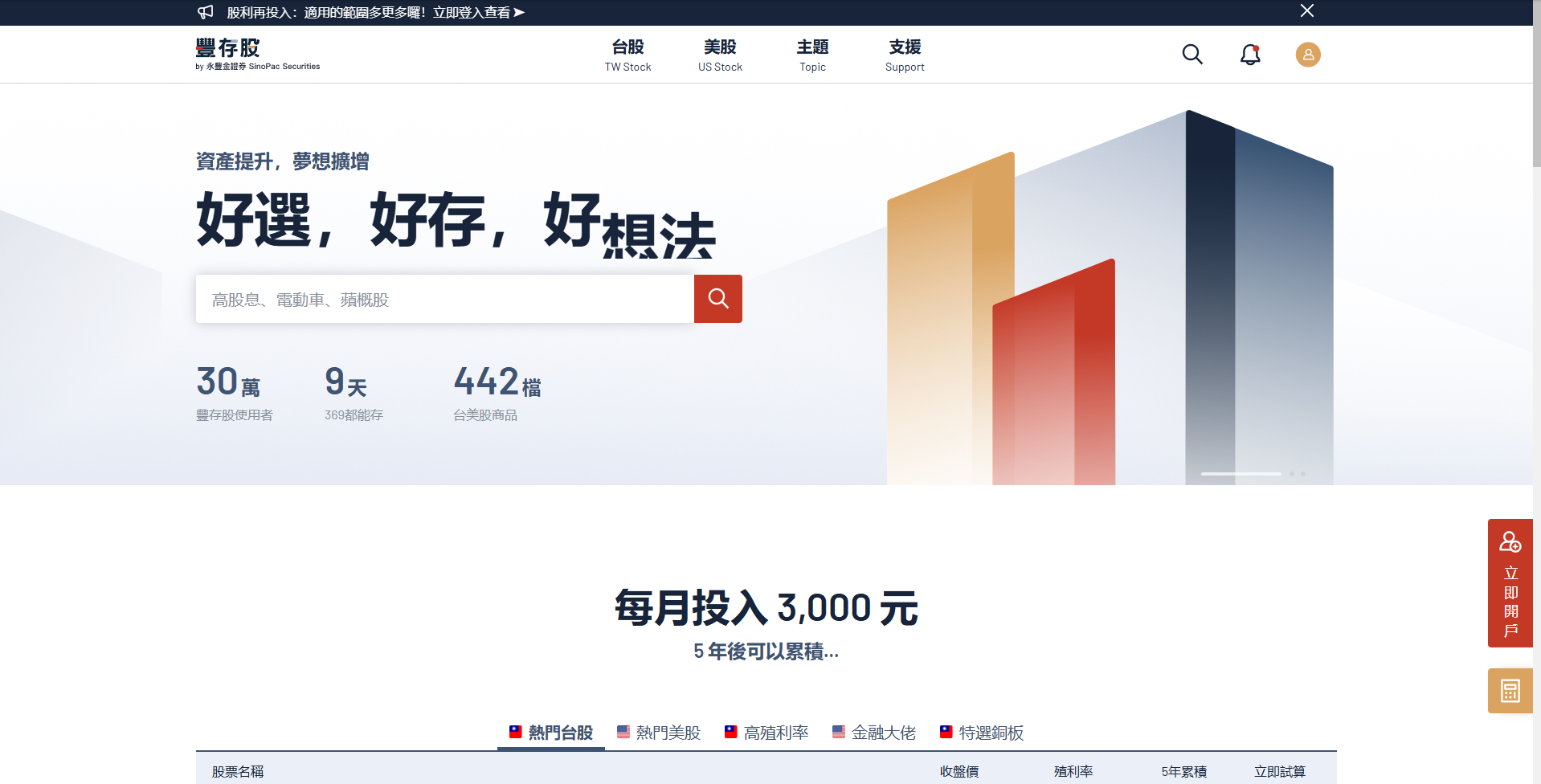
It’s too empty to just talk without practice, here I will directly use the “Yuanta Securities” App (豐存股 (Feng Cun Gu)) as an example to teach you how to complete your first fixed amount investment setting in US stocks.
Login and Account Opening
- First, you need to have an account with Yuanta Securities and have the sub-brokerage function enabled. If not, you can make an online appointment to open an account, which is very convenient.
Enter the “豐存股 (Feng Cun Gu)” Zone
- Open the Yuanta Securities App, and you can usually find the entrance to “豐存股 (Feng Cun Gu)” on the homepage.
Select the US Stock Market and Search for Targets
- After entering 豐存股 (Feng Cun Gu), select the “US Stock” market.
- Enter the ETF code you want to invest in in the search box, such as “VOO”.
Set up your fixed amount investment plan
- Select the deduction date: Yuanta provides 9 deduction dates per month, on the 3rd, 6th, 9th, 13th, 16th, 19th, 23rd, 26th, and 29th, which is very flexible.
- Enter the deduction amount: You can choose to deduct in “NTD” or “USD”, with a minimum of $10 USD or NT$3,000 NTD.
- Dividend Reinvestment: Be sure to check “Enable”! This is the key to making your snowball bigger and bigger.
Confirm and Submit
- Check whether all settings are correct, confirm and submit, and you’re done! Next, the system will automatically buy assets for you on the date you specify, opening your lazy financial management path.
Common questions for sub-brokerage novices (FAQ)
Extended reading
Too lazy to have a conclusion
Choosing which sub-brokerage is like choosing a mobile phone plan, there is no absolute best, only the one that suits you best.
- If you are a small capital family and the monthly investment amount is not high, Cathay and Yuanta’s ultra-low buy-in handling fees are definitely your first choice.
- If you are an ultimate lazy person and hope to maximize asset compounding, then Yuanta’s exclusive “dividend reinvestment” function is a must for you.
The most important thing is always that step——“Take action”.
Instead of spending countless hours comparing the difference of a few decimal points in fees, it is better to choose one today, set up your fixed amount investment, and let your money start working for you. This is the true essence of “too lazy to get rich”!
🚀 已有 1,000+ 讀者加入理財成長之路
👉 If you want to start directly, first go to the ETF Beginner Allocation Toolkit to decide on the monthly investment amount and ETF ratio, and then come back to choose a brokerage, the process will be smoother.
Data updates and sources (as of 2026-02-15)
- Cathay Securities US Stock Fixed Amount Investment Announcement ($0.1 USD / ETF Sell $3 USD): https://www.cathaysec.com.tw/cathaysec/personal/news/announcement/announcement/20250114_1
- Yuanta Securities 豐存股 (Feng Cun Gu) (NT$1 NTD / Foreign Currency $0.01 USD, Sell 0.18%): https://www.sinotrade.com.tw/richclub/invest/offer
- Capital Securities Official Website (US Stock Savings Pass and activities are subject to the latest announcement on the official website): https://www.capital.com.tw/
- KGI Securities Sub-brokerage Handling Fee (General Fee Description and Activity Period): https://www.kgi.com.tw/zh-tw/campaign/overseas_stocks_fee/
- Fubon Securities US Stock Fixed Amount Investment Function Page (Minimum Subscription Threshold and Services): https://www.fubon.com/securities/home/online-trading/platform/us-stock/regular-quotas/
想學習更多相關知識?
返回 VOO 投資中心 📚

![[2025 Complete Guide] VOO Sub-Brokerage for Beginners: From Opening an Account to Your First U.S. ETF Trade](/images/blog/20250910.png)