Magnificent Seven (M7) vs. VOO: The Ultimate Showdown — Should You Bet on the "Seven Warring States" or Invest in the "Unified Empire"?
In this article, you'll learn:
Have you ever heard your friends say: “Why bother with VOO? That’s way too slow! Just go all-in on the seven most powerful stocks — the Magnificent Seven (M7) — and fast-track your way to financial freedom!”
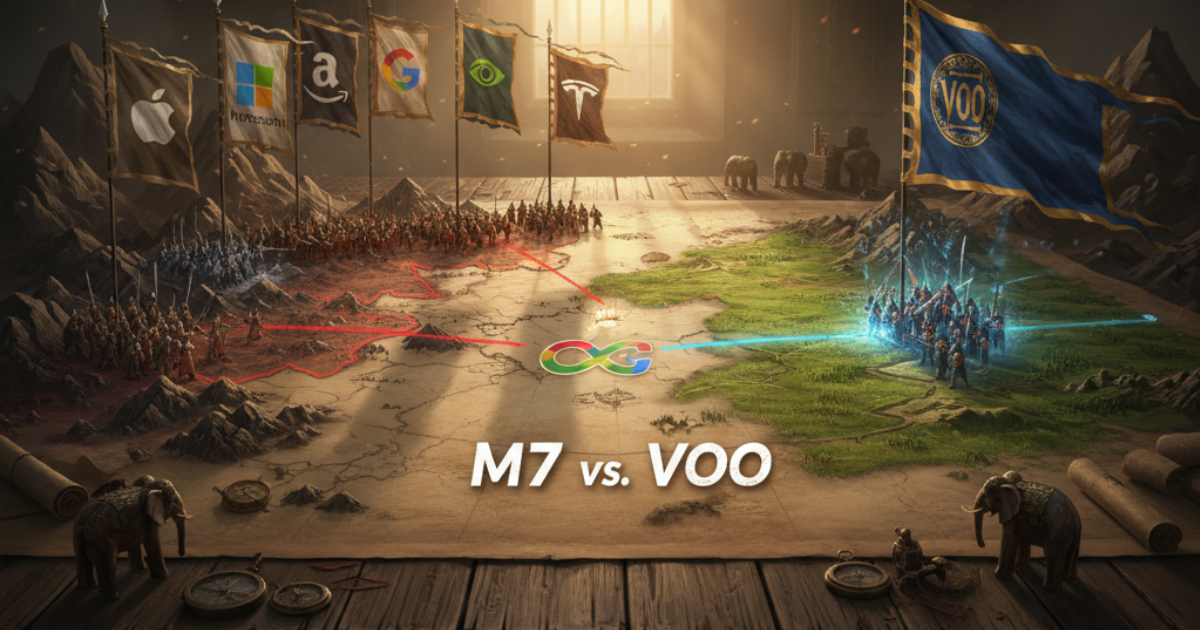
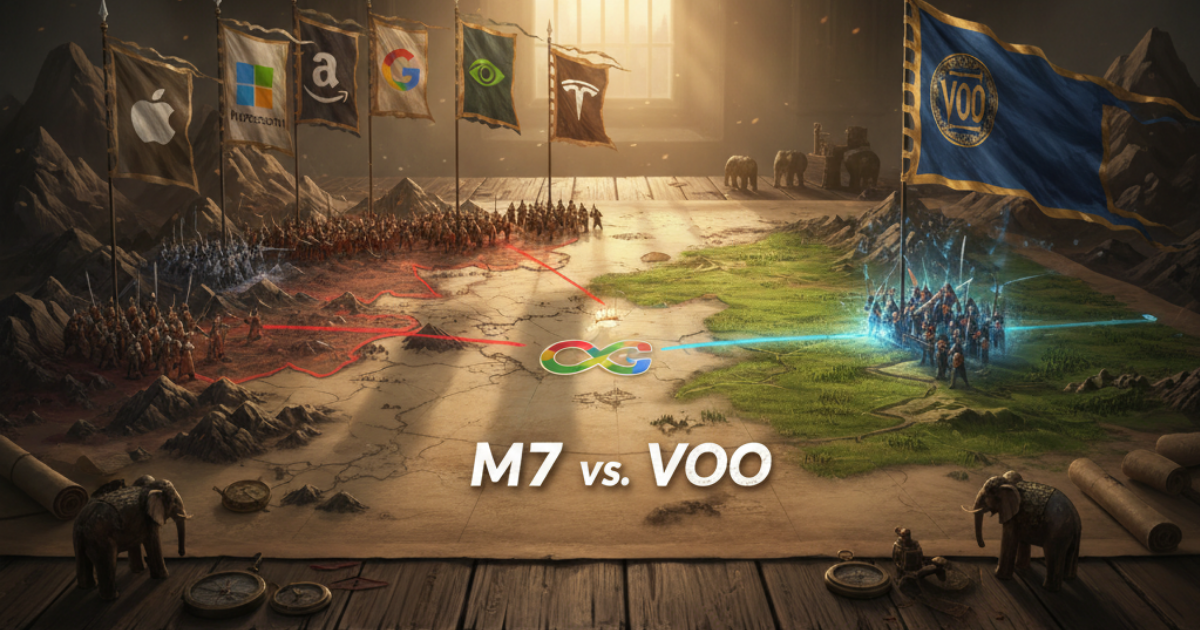
That line is probably one of the most heated debates in the investment world over the past few years. On one side are the M7 tech giants — like the “Seven Warring States” (戰國七雄), each dominating their own kingdom. On the other side sits VOO — the “Unified Empire” that spans all 500 of America’s top companies.
What’s the real difference between these two? How should everyday investors like us choose? Today, let me — your resident lazy investor, Lazy Da — walk you through this ultimate investment showdown using the simplest historical story possible. Before making a decision, we need to look beyond the current glory and learn from history: what happened to those who were once the undisputed “king”?
Info
💡 Want to learn more about VOO investment strategies? Visit the VOO Investment Knowledge Hub for a complete guide from beginner to advanced!

Lazy Da’s Confession: From All-In Gambler to Planting Trees — My Investment Awakening
Before diving into the analysis, I want to share my own story. In my younger days, I was a true believer in the M7 approach — and even more extreme. I traded warrants and individual stocks, chasing the thrill of “invest today, double tomorrow.” It was like an emotional roller coaster you just can’t quit. During the day I was obsessed with making money; at night I lay awake worrying about losing it. My life was completely hijacked by market emotions.
During that period, I made money — but never actually kept it. Whatever I earned would quickly vanish from one bad call, sometimes at a loss. After going around in circles, I finally realized: what I should have been chasing all along wasn’t “a lot of money,” but “the money I actually need” — a number that lets me sleep at night and live well during the day.
From that point on, I switched my investment approach from “growing bean sprouts” to “planting trees.” Instead of chasing quick harvests, I chose a good index (a patch of fertile land) and made regular contributions (planting seeds, watering them), patiently waiting for them to grow. That’s the journey that transformed me from a gambler hoping to win by surprise to a farmer who simply believes in the nation’s long-term prosperity.
The Seven Warring States of Tech: The Rise of Seven Kingdoms
Let’s get back to the topic and paint a portrait of these seven tech powers, understanding how they built their dominance:
Qin: Apple — Like the powerful Qin state, Apple built its empire through a closed yet formidable iOS ecosystem, establishing unified standards (App Store rules and MFi certification), commanding the most loyal citizens (devoted Apple fans), and creating near-impenetrable walls through absolute hardware-software integration.
Qi: Microsoft — Like the prosperous Qi state that dominated the central plains for ages, Microsoft’s Windows and Office systems became the universal language of business. With Azure cloud services expanding into new territory in recent years, it remains a deeply-rooted traditional powerhouse.
Chu: Amazon — Like the vast and resource-rich Chu state, Amazon’s e-commerce empire (Amazon.com) and cloud dominance (AWS) span every corner of modern life. Its logistics network, like Chu’s navy, reaches everywhere and controls the arteries of commerce.
Zhao: NVIDIA — Like Zhao, which rose through military reform (the “Hu Fu Qi She” cavalry-and-archery transformation), NVIDIA’s GPU technology revolutionized warfare on the AI battlefield. It has become the new military superpower — every nation (company) must buy its arms (chips).
Yan: Google (Alphabet) — Like Yan, which controlled key trade routes and intelligence flows, Google’s search engine and Android system control the flow of information and digital entry points. Whoever controls knowledge controls the narrative.
Han: Meta (Facebook) — Like Han, situated at the crossroads and skilled at coalition-building, Meta connects billions of people through its social networks (Facebook, Instagram, WhatsApp), commanding the most complex and valuable “human relationship” network.
Wei: Tesla — Like Wei, the first to implement major reforms, Tesla leads trends through disruptive innovation (electric vehicles, autonomous driving), boldly challenging the old order. Its development path, however, is full of variables and controversy — making it an iconoclastic reformer.
And VOO (Vanguard S&P 500 ETF) is the “Unified Empire” that incorporates all seven great powers — plus over 400 other states — into one territory. As the father of index funds, John Bogle, famously said:
Don’t look for the needle in the haystack. Just buy the haystack.
― John Bogle
VOO is the very best embodiment of that philosophy.

Lessons from History: From the “Nifty Fifty” to the Fall of the HTC Dynasty
Just as we get excited about M7’s staggering returns, history serves us an important reminder. Back in the 1970s, Wall Street had its own group of superstar stocks proclaimed as “buy once, hold forever” investments — they were called the “Nifty Fifty.” These fifty companies — including Coca-Cola, IBM, and Polaroid — were considered “forever-growth” stocks. Then came the 1973–1974 bear market, and the myth shattered. Many Nifty Fifty stocks tumbled more than 50%, some even 80%.
A closer example: HTC, once Taiwan’s “stock king.” In 2011, HTC nearly ruled the Android world, with a market cap that briefly surpassed Nokia. But following Apple’s patent lawsuits and bans, its market share collapsed and its stock price plummeted from the clouds to the ground. These stories reveal a harsh truth:
Price is what you pay. Value is what you get.
― Benjamin Graham
This famous quote from the father of value investing, Benjamin Graham, perfectly captures the lesson of history: no matter how great a company is, buying at too high a price or ignoring competitive and environmental shifts can still make it a terrible investment.
The Deep Dive: M7 vs. VOO — A Full Comparison
With that historical perspective in mind, let’s look at the current matchup. Now that we know the players, let’s examine the data and characteristics directly.
| Item | M7 (Magnificent Seven) | VOO (Vanguard S&P 500 ETF) | Lazy Da’s Take |
|---|---|---|---|
| What You Get | 7 major US tech stocks | Tracks the S&P 500, covering ~500 large US companies | Seven kingdoms each ruling themselves |
| Diversification | Extremely concentrated in tech and growth | Highly diversified across financials, healthcare, industrials, and more | Betting on a single power vs. investing in the whole empire |
| Weight in VOO | ~27–32% of VOO’s market cap | — | The seven lords already hold the most power in the empire |
| Risk & Volatility | Extremely high returns and volatility — could conquer all, or collapse overnight | Relatively diversified risk, pursuing steady national growth | Riding a warhorse vs. sailing a royal ship |
| Historical Lesson | Like the Nifty Fifty and HTC — beware of overvaluation and industry disruption | Automatically weeds out weak players, better suited to navigate market cycles | Betting on star players vs. investing in the whole league |
| Best Suited For | High-growth seekers, risk-tolerant strategists who believe they can pick the winner | Diversification seekers who want steady market participation — the lazy investor | Thrill-seekers vs. those who want to sleep soundly |
The Numbers Speak: M7’s Stunning Performance — and the Warning Signs
From 2015 to 2024, M7’s total return reached nearly 700%, far outpacing the S&P 500’s 178%. But don’t forget the one exception: in 2022, the S&P 500 fell roughly 20% while M7 crashed more than 41%. That perfectly illustrates the two sides of “high reward, high risk.”
The Key Point: The VOO Empire You Buy Already Runs on M7 Power
From the table above, you’ll notice one fascinating key fact: the seven M7 lords together account for nearly 30% of the entire VOO empire’s economic might!
This means that when you buy VOO, you already benefit from the growth of those seven powers — you just also hold the “tax revenues” from the other 493 territories to help spread your risk. You expand alongside the lords, but when any one lord weakens due to war or internal conflict, the empire’s foundation remains solid.

How to Put It Into Practice: The Lazy Investor’s “Core-Satellite” Asset Allocation
So, is there a way to enjoy M7’s growth momentum while maintaining VOO’s stability? Absolutely! That’s the “Core-Satellite” strategy commonly used by professional investors — and the investment allocation I personally use because it’s comfortable for me.
Want to dive deeper into the core principles of asset allocation? Recommended reading: 2 Key Points of Asset Allocation.
Before talking about any specific ratio, I want to bust a myth: age does not equal risk tolerance. A 25-year-old engineer isn’t necessarily aggressive, and a 55-year-old teacher isn’t necessarily conservative. The real question is: What plans do you have for your future? Does your financial plan support your choices?
Core — 70%~80%: Put the majority of your funds into a stable, diversified index ETF like VOO. This is your portfolio’s “imperial foundation,” responsible for delivering steady long-term growth. To learn more about VOO and other mainstream ETFs, check out: VOO, QQQ, VT — How to Choose? A Guide to 10 Popular ETFs.
Satellite — 20%~30%: Use the remaining funds as your “advance force.” In my case, I make a fixed monthly investment in individual stocks from the M7 (or even M10 — the top ten by market cap), but this position is strictly controlled as a percentage of my total portfolio. My largest position will always be in a reassuring index ETF.
This allocation lets you “win through stability” — you won’t miss the tech giants’ growth train, but the bulk of your assets grows steadily with the market, letting you sleep soundly at night.
Frequently Asked Questions (FAQ)
Further Reading
The Lazy Conclusion

Investing is like choosing a side in history. Do you want to be a strategist with unique insight, betting heavily on one lord (M7) to unify the world? Or would you rather be a steady farmer, investing in the whole continent (VOO), trusting that no matter who wins or loses, the land will eventually yield a harvest?
The historical “Nifty Fifty” and the HTC dynasty remind us that betting on a single dominant power carries extreme risk. For most people:
- If you want peace of mind, steady, lazy investing — and sleep well at night — then investing in VOO, the “Unified Empire,” is absolutely your best choice.
- If you’re a true believer in technology and willing to trade high volatility for high returns, then using a “Core-Satellite” strategy to make M7 the elite force in your empire is the smarter move.
Understanding your own investment personality matters far more than guessing who the next hegemon will be. Because ultimately, you are 100% responsible for your choices.
I’m Lazy Da — I hope this article helps you find the most comfortable balance between conquering kingdoms and governing an empire.
🚀 已有 1,000+ 讀者加入理財成長之路
Data Sources and Updates (as of 2026-01-31)
- VOO Official Product Page:
https://investor.vanguard.com/investment-products/etfs/profile/voo - QQQ / S&P 500 Historical Performance Reference:
https://www.invesco.com/us-rest/contentdetail?contentId=841e411c-a1eb-4541-8cb8-0fa603abea81&dnsName=us - M7 Definition and Composition Reference: Investopedia
https://www.investopedia.com/magnificent-seven-stocks-8402262
📚 More VOO Investment Knowledge: Back to the VOO Investment Knowledge Hub
View the complete VOO investment guides and strategy analysis