How Much Will Labor Insurance and Labor Pension Pay You in Retirement? 9 Visual Q&As + What to Do in Your 20s to 60s
How much do Labor Insurance and Labor Pension pay in retirement? On the median monthly wage of NT$39,629 with 30 years of service, the Labor Insurance pension is about NT$21,000 and the Labor Pension …
M
懶大
|7 分鐘閱讀
|更新:2026-10-29
In this article, you'll learn:
This week I posted several short videos about Labor Insurance (勞保), and the most common comment underneath was:
“If I won’t live long, what’s the point of the pension?”
Others said similar things: “Not sure I’ll even live that long,” “Eight years to break even? That’s about when men die anyway,” and “I’m claiming now, because I won’t live long 😂.”
After reading them one by one, my biggest takeaway was this: everyone worries about not living long enough, but the data says the real risk is living too long and running out of money.
In this post I’ve turned everything into visuals: how Labor Insurance and the Labor Pension (勞退) pay out, the latest life expectancy data, and the questions that came up most in the comments. At the end there’s a checklist for each age group, 20, 30, 40, 50 and 60. Find your row and start there.
All figures are as of October 2026. Payout estimates follow the formulas in the Labor Insurance Act and the Labor Pension Act. For your actual amount, use the Bureau of Labor Insurance’s calculator.
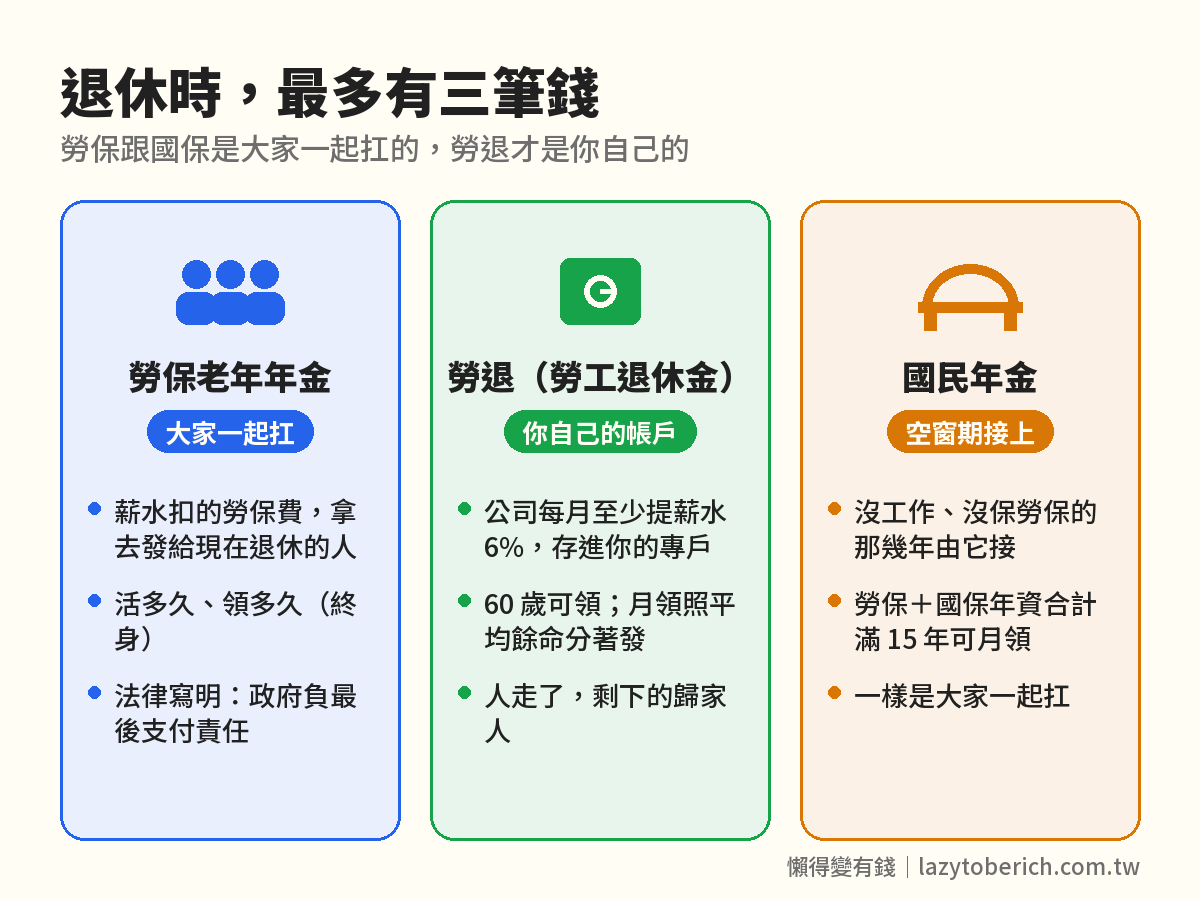
First: you can have up to three retirement payouts
A lot of people mix up Labor Insurance and the Labor Pension. They’re completely different things. Add the National Pension (國民年金) for the years you weren’t working, and that’s three payouts in total.
Labor Insurance old-age pension: The premium deducted from your paycheck each month goes to people who are retired right now. It works like a relay race, not a piggy bank. It pays for as long as you live.
Labor Pension: Your employer puts at least 6% of your wage into your own personal account every month. This is your money. If you pass away, what’s left goes to your family.
National Pension: It covers the years when you weren’t working and weren’t in Labor Insurance. If your Labor Insurance years fall short of 15, but Labor Insurance plus National Pension years add up to 15, you can still get a monthly pension.
In one sentence: Labor Insurance and the National Pension are shared by everyone. Only the Labor Pension is truly yours.
Median earner, 30 years of work: how much per month in retirement?
I’m using Taiwan’s median wage, not the average. The average gets pulled up by high earners; the median is the person standing right in the middle.
According to the latest DGBAS figures, the median regular monthly wage for all employees in July 2026 was NT$39,629. In other words, half of all workers earn less than this each month.
Here’s the math for 30 years of service, starting payouts at 65.
Payout one: the Labor Insurance pension. The monthly pension is based on your “highest 5 years” of insured salary. After 30 years with some raises, there’s a good chance you hit the cap in your final years, so I’m calculating straight at the insured salary cap of NT$45,800. The formula is “average monthly insured salary × years of service × 1.55%”:
45,800 × 30 × 1.55% ≈ NT$21,297 per month
Payout two: the Labor Pension. A NT$39,629 wage falls in the NT$40,100 contribution bracket. Your employer puts in 6%, which is NT$2,406 a month. I’m being conservative here: no raise at all for 30 years and a 3% annual return. At 65, your account would hold about NT$1.4 million. Paid monthly under the Bureau of Labor Insurance’s current basis, a statutory remaining life expectancy of 19 years when claiming at 65 and an interest rate of 1.1473%, that’s about NT$6,800 a month, paid until age 84.
Add them up and you get about NT$28,000 a month, roughly 70% of your current pay.
To be clear, the two assumptions aren’t the same: for Labor Insurance I assume you hit the cap in your final years, while for the Labor Pension I conservatively assume no raise at all for 30 years. If your insured salary stays at NT$40,100, Labor Insurance pays NT$18,647, the two payouts add up to about NT$25,000, just over 60% of your pay, and the gap grows to about NT$14,000.
展開原始數據
切換 Tab 後更新
If you earn less than the median, both payouts will be smaller. The Labor Pension is 6% of your wage, so a lower wage means a smaller account. If your insured salary never reaches the cap, your Labor Insurance pension is lower too. These are the people who most need to set aside extra money on their own and dollar-cost average into ETFs for retirement. That’s how I fill my own gap.
There’s another difference many people miss:
The Labor Insurance pension is for life. Live to 95, and it pays until 95.
The Labor Pension monthly payout is not for life. The law says it’s “calculated based on the annuity life table, average life expectancy and interest rates.” In other words, it’s only paid up to the day you reach the statutory life expectancy. The Bureau of Labor Insurance currently uses the Ministry of the Interior’s 2022 life table: claim at 60 and it pays for 23 years, to age 83; claim at 65 and it pays for 19 years, to age 84. Outlive that day, and the account runs dry.
So the longer you live, the more that NT$21,000 from Labor Insurance matters, and the NT$12,000 gap is something only you can fill.
“I won’t live long anyway”? Look at the life expectancy data first
This was the section I most wanted to write after reading the comments.
Many people think about their own lifespan using “average life expectancy of 81.” But that number describes a newborn baby, and it includes people who die young from accidents or illness.
Once you’ve already made it to 60, you’ve survived those risks, so your expected lifespan is longer than 81.
From the Ministry of the Interior’s 2025 abridged life table, here’s how many more years people at each age can expect to live:
展開原始數據
切換 Tab 後更新
This is what I covered in my video “Claim Labor Insurance early at 60 or late at 70?”: claiming at 60 versus 65 breaks even at 85, and the average expected lifespan of a 60-year-old in Taiwan is right around 85.
展開原始數據
切換 Tab 後更新
And life expectancy is still going up
It’s not just Taiwan.
Taiwan: it dipped during the pandemic and is now back to pre-pandemic levels. The Ministry of the Interior’s report says that apart from the last 3 years of pandemic impact, life expectancy “has been on a long-term upward trend.” In 2025 it was 81.27, up 0.50 from the year before and back to pre-pandemic levels. Compared with 10 years earlier (2015), remaining life expectancy at 60 rose by 0.91 years, and at 70 it went from 16.13 to 17.03 years.
展開原始數據
切換 Tab 後更新
Worldwide: another 4 to 5 years on average by 2050. The Global Burden of Disease study (GBD 2021) published in The Lancet in 2024 forecasts that global life expectancy will rise from 73.6 in 2022 to 78.1 in 2050.
But the same study also flagged something: “healthy” life expectancy only rises by 2.6 years. Some of those extra years will be spent living with illness. For retirement planning, that means your money has to last longer, and you need to budget for medical and long-term care costs later in life.
To be fair, other research (Olshansky et al., Nature Aging, 2024) points out that the pace of life expectancy gains in long-lived countries is slowing, and everyone living to 100 is unlikely. But “slowing down” isn’t “going backwards.” The direction is still up.
So the assumption “I won’t live long” is actually the most dangerous one to plan your retirement around. If you’re wrong, you’ll be broke in your 80s.
The 9 questions people asked most in the comments
If you already know your health is poor, claiming early or taking the lump sum may make more sense. That’s a very personal call; in my early-vs-late video I also said “what really matters is your health and whether you need the cash.” But if it’s just a “feeling” that you won’t live long: a 60-year-old in Taiwan can expect to live another 24.89 years. With an insured salary of NT$45,800 and 30 years of service, the monthly pension breaks even in a little over 8 years. Start at 65, and by 73 you’ve matched the lump sum. I’ll take the pension myself, and fill the rest of the gap by investing in ETFs.
Not necessarily. Under Article 63-1 of the Labor Insurance Act, if you pass away while receiving the pension, eligible family members can claim a survivor’s pension. If you had Labor Insurance service before 2009 (before the amendment took effect on July 17, 2008), your family can also choose the “difference payment”: the lump sum you would have received, minus what you’ve already been paid, paid out in one go. The Labor Pension is simpler: if you pass away while receiving monthly payments, whatever is left in your account goes to your family or a designated claimant (Article 26 of the Labor Pension Act).
On December 30, 2025, the Legislative Yuan passed an amendment writing into the Labor Insurance Act that “the central government bears ultimate responsibility for paying Labor Insurance.” The shortfall is real: in 2025 the fund collected NT$524.2 billion in premiums and paid out NT$595.0 billion, a gap of NT$70.7 billion, covered by government top-ups and investment returns. My view: getting nothing at all is very unlikely. Higher premium rates, reduced benefits or more tax money are more likely. So don’t rush to claim early out of fear. Treat Labor Insurance as the floor, and build the rest of your retirement yourself. I went through all the numbers in my long video “Will Labor Insurance really go bankrupt?”
It depends on whether you die “before you start claiming” or “after.” If you have 15 years of Labor Insurance service and already qualify to claim but haven’t yet, eligible family members can claim a survivor’s pension; if you had service before 2009, they can also choose a one-time old-age payment. If you were already receiving the pension, see Q2: survivor’s pension or the difference payment. For the Labor Pension, if you die before claiming, your family or a designated claimant receives it as a lump sum.
For people born in 1962 (ROC year 51) or later, the full pension starts at age 65 from 2026. You can claim up to 5 years early, with 4% less for each year early, or up to 5 years late, with 4% more for each year you wait. Whenever you claim, you must first leave your job and end your Labor Insurance coverage. With fewer than 15 years of service, you can’t get the monthly Labor Insurance pension, only a lump sum (unless combined with National Pension years).
It depends on whether you keep working and stay covered by Labor Insurance during those 5 years. If you do, your service keeps adding up. If you simply stop working and apply later, your service doesn’t grow, but the “deferred claim” rule applies: 4% more for each year you wait. To see which works out better, use the Bureau of Labor Insurance’s old-age pension calculator.
That’s the fact: the maximum insured salary for Labor Insurance is NT$45,800. Even someone earning NT$100,000 a month is calculated at NT$45,800. So the higher your pay, the smaller the share Labor Insurance replaces. The Labor Pension is different, with a contribution wage cap of NT$150,000, so higher earners build a much bigger Labor Pension. That’s why high earners need to rely more on the Labor Pension and their own investments.
The lump sum only looks at your average insured salary over the 3 years before you leave; the monthly pension looks at your highest 5 years. At NT$45,800 with 30 years of service, the lump sum is about NT$2.06 million. If your last 3 years drop to the minimum wage of NT$29,500, it falls to NT$1.33 million, NT$730,000 less. So if you’re taking the lump sum, don’t take a pay cut in your last 3 years; if you’re taking the monthly pension, a pay cut doesn’t matter. (Only people with Labor Insurance service before 2009 can choose the lump sum.)
There are two groups. People who kept their old-system years when switching to the new system (for example, 4 years under the old system and 21 under the new): the old-system portion is normally paid by your employer only when you meet the Labor Standards Act retirement conditions and actually retire from that company. But Article 11 of the Labor Pension Act lets you and your employer agree to settle it while you’re still employed, at no less than the Labor Standards Act retirement calculation. So you can negotiate, but if your employer says no, that’s it. “Pure old-system” workers who never switched: since July 17, 2026, those who are already making voluntary Labor Pension contributions and meet the old-system retirement conditions can sign a written agreement with their employer to move their entire old-system pension into their own Labor Pension account while still employed. This isn’t cash, though; you still generally can’t withdraw it until 60. Both routes require your employer’s agreement, so check with HR first.
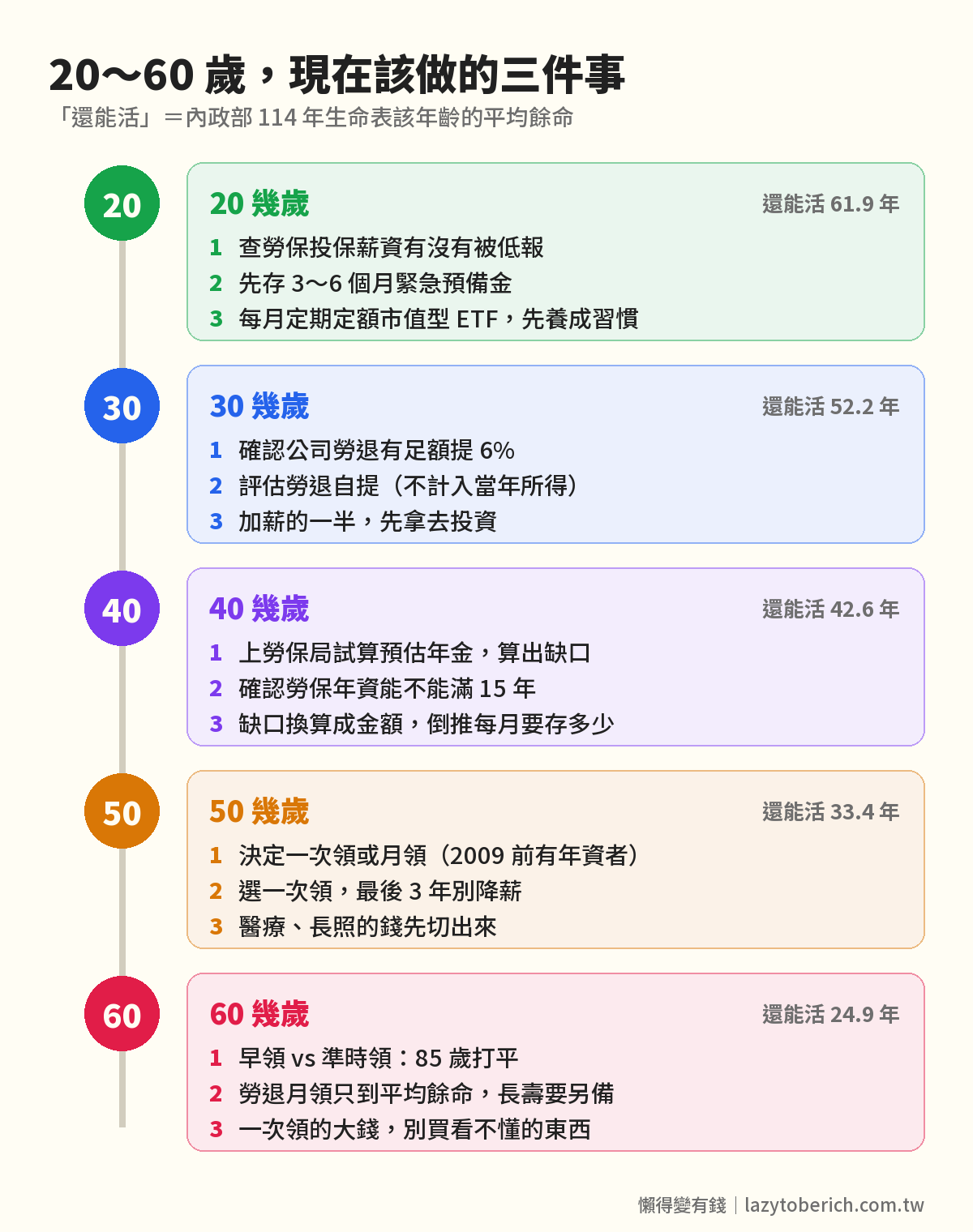
Ages 20 to 60: what to do right now
Retirement planning doesn’t start at 60. I’ve boiled each age down to three things. Find your row and start there.
In your 20s: time is your biggest asset. Use the Bureau of Labor Insurance’s online services to check that your insured salary hasn’t been under-reported (under-reporting means a smaller pension later). Save 3 to 6 months of living expenses as an emergency fund. Then put a fixed amount into a broad-market ETF every month. The amount can be small; just build the habit.
In your 30s: your income starts to grow, and you still have 30 years of compounding. Make sure your employer is contributing the full 6% to your Labor Pension. Consider voluntary Labor Pension contributions: they’re excluded from that year’s taxable income, so the higher your tax bracket, the better the deal. When you get a raise, invest half of it first and let your lifestyle grow only with the other half.
In your 40s: time to calculate your gap. Use the Bureau of Labor Insurance’s calculator to estimate your pension and work out your monthly shortfall. Check whether you can reach 15 years of Labor Insurance service (under 15 means lump sum only). Turn the gap into a total amount you’ll need at retirement, then work backwards to how much to save each month.
In your 50s: how you claim becomes a real decision. If you had Labor Insurance service before 2009, decide between the lump sum and the monthly pension; if you’re taking the lump sum, don’t take a pay cut in your last 3 years. If you have old-system pension years, check with your employer how they’ll be settled. Set aside money for medical and long-term care before anything else.
In your 60s: how you claim depends on your health and cash needs. Claiming early at 60 and on time at 65 break even at 85; if you’re healthy and don’t need the cash, there’s no rush to take a 20% cut. The Labor Pension monthly payout only lasts until average life expectancy, so plan for the years beyond that. A big lump sum is the easiest money to lose, so don’t put it into things you don’t understand.
Know your three payouts: Labor Insurance and the National Pension are shared by everyone; only the Labor Pension is truly yours
Median wage, 30 years of work: about NT$21,000 from Labor Insurance plus about NT$6,800 from the Labor Pension, roughly NT$28,000 a month, or 70% of current pay; if you earn below the median you’ll get less, so investing in ETFs on your own matters even more
Don’t decide based on “I won’t live long”: a 60-year-old in Taiwan can expect another 24.89 years, the older you get the longer your expected lifespan, and life expectancy is still rising
Labor Insurance pays for life; the Labor Pension monthly payout only lasts until average life expectancy: the longer you live, the more the Labor Insurance pension matters
Fill the gap yourself: I treat Labor Insurance as my floor, and cover the rest by dollar-cost averaging into ETFs
You’re worried about not living long enough. I’m more worried you’ll live too long without enough money.
📩
訂閱電子報,獲取更多理財觀點
🔒 免費訂閱,隨時可退訂
Videos in this series
Will Labor Insurance really go bankrupt? I covered the actuarial reports, the Bureau of Labor Insurance’s books and the lessons from the US Social Security system in this long video:
Ministry of the Interior, Summary Analysis of the 2025 (ROC 114) Abridged Life Table (published 2026-08-24): life expectancy of 81.27, remaining life expectancy by age, 10-year trend