Bollinger Bands (BBand) Ultimate Guide: From Parameter Settings to Practical Strategies, a Statistician’s Stock Picking Secrets
- 懶大 (Lazy Da)
- 財務工具與金融商品
- Last updated: September 29, 2023
- 3 min read
In this article, you'll learn:
Bollinger Bands are one of my favorite technical indicators, mainly because they are based on the principles of “statistics.” Theoretically, I personally prefer rational thinking, so I prefer concepts with data statistics. Of course, these concepts will form decision factors, but data is always a reference.
Standard Deviation in Statistics
Standard deviation is used to measure the dispersion of a set of data. If the standard deviation of a set of data is large, it means that the numerical differences in the data are large, that is, the numerical values in the data are far from the average value. If the standard deviation of a set of data is small, it means that the numerical differences in the data are small, that is, the numerical values in the data are close to the average value.
For example, suppose we have a set of students’ height data, and the average height is 170 cm. If the standard deviation is large, it means that some students may be only 150 cm tall, while others may be 190 cm tall. If the standard deviation is small, it means that all students are close to 170 cm tall.
Normal Distribution (Wikipedia)
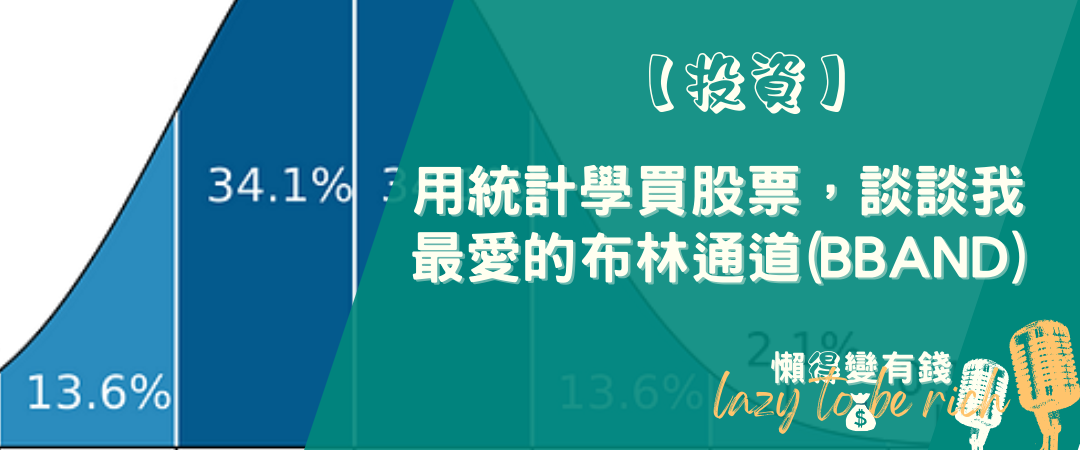
In practical applications, it is often considered that a set of data has a probability distribution that approximates a normal distribution. If the assumption is correct, then approximately 68% of the values are distributed within a range of 1 standard deviation from the mean, approximately 95% of the values are distributed within a range of 2 standard deviations from the mean, and approximately 99.7% of the values are distributed within a range of 3 standard deviations from the mean. This is called the “68–95–99.7 rule.”
Standard deviation is one of the most important indicators in statistics, which can help us better understand whether the average deviates from the data.
Applied to Stock Price Statistics
Bollinger Bands are a type of technical analysis indicator invented by John Bollinger in the 1980s. Bollinger Bands consist of three lines:
Middle Band (Orange): This is the moving average line, usually using a 20-day moving average.
Upper Band (Purple): This is the middle band plus two standard deviations.
Lower Band (Orange): This is the middle band minus two standard deviations.
5-day Moving Average (Green): I personally like to use this to look at short-term strength.
10-day Moving Average (Yellow): I personally like to use this to look at medium-term strength.
In the figure, you can see that the green arrow indicates that the stock price has touched the extreme value of the standard deviation (which is about a 5% probability). At this time, it may be in a state of the bands opening and a strong rise.
The red arrow indicator also shows that the stock has touched the extreme value of the standard deviation, which must be below the monthly line (20-day moving average), and it may also be in a state of the bands opening and going down.
I personally do not recommend shorting stocks when the stock price is at the upper edge of the band, but I will buy when the stock price is at the lower edge. The reason is that stocks usually fluctuate around the “middle line.” Once they deviate from the band, especially when they touch the lower band, it is a “bargain hunting” opportunity. Imagine that there is an item with only a 5% chance of being on sale, and when the stock touches the lower edge, this opportunity has arrived.
This is also why I personally like this technical indicator. Part of the basis comes from reliable statistics.
However, the Future is Unpredictable
Bollinger Bands can be used to analyze price fluctuations. When the price is above the upper band, it indicates that the price is high and may fall back. When the price is below the lower band, it indicates that the price is low and may rise. Bollinger Bands can also be used to determine trends. When the price fluctuates within the Bollinger Bands, it indicates that the trend is unclear. When the price breaks through the upper band, it indicates an upward trend; when the price breaks through the lower band, it indicates a downward trend. Bollinger Bands are a simple and easy-to-use technical analysis indicator, although it can help us analyze price fluctuations and trends. However, the stock price is not a number that can be predicted in the future. And usually, there are too many factors affecting the rise and fall of a single stock.
Therefore, I personally rarely use Bollinger Bands on individual stocks, because the rise and fall of individual stocks cannot rely on statistics at all, but I will use them in “index investing.” The larger the index range, the lower the probability of touching the upper band (because it is more average), and vice versa, the probability of touching the lower band is also low. Therefore, the index is one of the best financial products to operate in a range through Bollinger Bands.
It would be ridiculous to predict the future with just one BBand. Everyone would just buy by looking at the bands! But then again, you really just buy by following the bands! Participate in the market when it rises, and buy bargains when it falls. Damn! That’s like saying nothing at all. When should you buy and when should you sell?
Didn’t I just say, participate in the market when it rises and sell bargains when it falls! The question is, do you know why you should buy or why you should sell?
When to buy and when to sell completely depends on the content of each person’s own financial plan. I like this article by Ichiro Suzuki the most, which completely captures the key points of financial planning.
Further Reading
懶得變有錢 (Lazy to Get Rich)’s Conclusion

🚀 已有 1,000+ 讀者加入理財成長之路