How to Do Asset Allocation? 2024 Beginner’s Guide: 3 Steps to Build Your Stable Investment Portfolio
- 懶大 (Lan Da)
- 財務工具與金融商品
- Last updated: September 23, 2023
- 3 min read
In this article, you'll learn:
Info
💡 Want to learn more about VOO investment strategies? Visit the VOO Investment Knowledge Center
summary: “How to do asset allocation? This article cracks the real secret of “don’t put all your eggs in one basket”, deeply analyzes the two core principles of “diversified investment” and “risk reduction”, and teaches you how to create the most suitable stable investment portfolio through the “rebalancing” strategy.”
The Concept of Asset Allocation
Before talking about asset allocation, I need to explain in plain language what asset allocation is. It’s “don’t put all your eggs in one basket,” everyone knows this. The purpose is to avoid breaking all the eggs at once. In addition to not putting eggs in a basket, it is best to find a place where these eggs can hatch, so that there is a constant stream of chickens laying eggs and eggs hatching into chickens. The question is, have you done it?
Know What You Want Before Asset Allocation
First of all, when it comes to investing and financial management, you must first think about “what kind of life do you want to live?” When this can be decided, then consider whether you need to invest, because investment always has risks. Never simply pursue returns and forget the risks you may bear. “Pure return gambling behavior” is not part of financial management, because that is really just gambling!
The purpose of asset allocation is to “diversify investment” and “reduce risk”. If these two principles can be met, an investment plan for the investment tool can be formulated.
The Concept of Asset Allocation
Whether NT$1 million (about USD$30,000) is too little depends on what kind of tools you want to invest in. Is it just fixed deposits, savings deposits, or insurance, or stocks or funds? Maybe real estate and land?
If it is real estate, NT$1 million (about USD$30,000) is of course too little. In the stock market, NT$1 million (about USD$30,000) can achieve diversified investment, but if the stock price is too high, it will not be possible to diversify investment (buying 2 individual stocks is not called diversified investment, buying 2 types of stocks has a chance to be called diversified investment).
Taking fund investment as an example, the simplest asset allocation is to allocate the proportion of global equity funds and global bond funds. Global equity funds have already diversified investment in a basket of stocks for investors, and global bond funds have also invested in a basket of bonds. First, it meets the requirement of “diversifying risk”.
2 Principles of Allocation
Principle 1: Diversified Investment
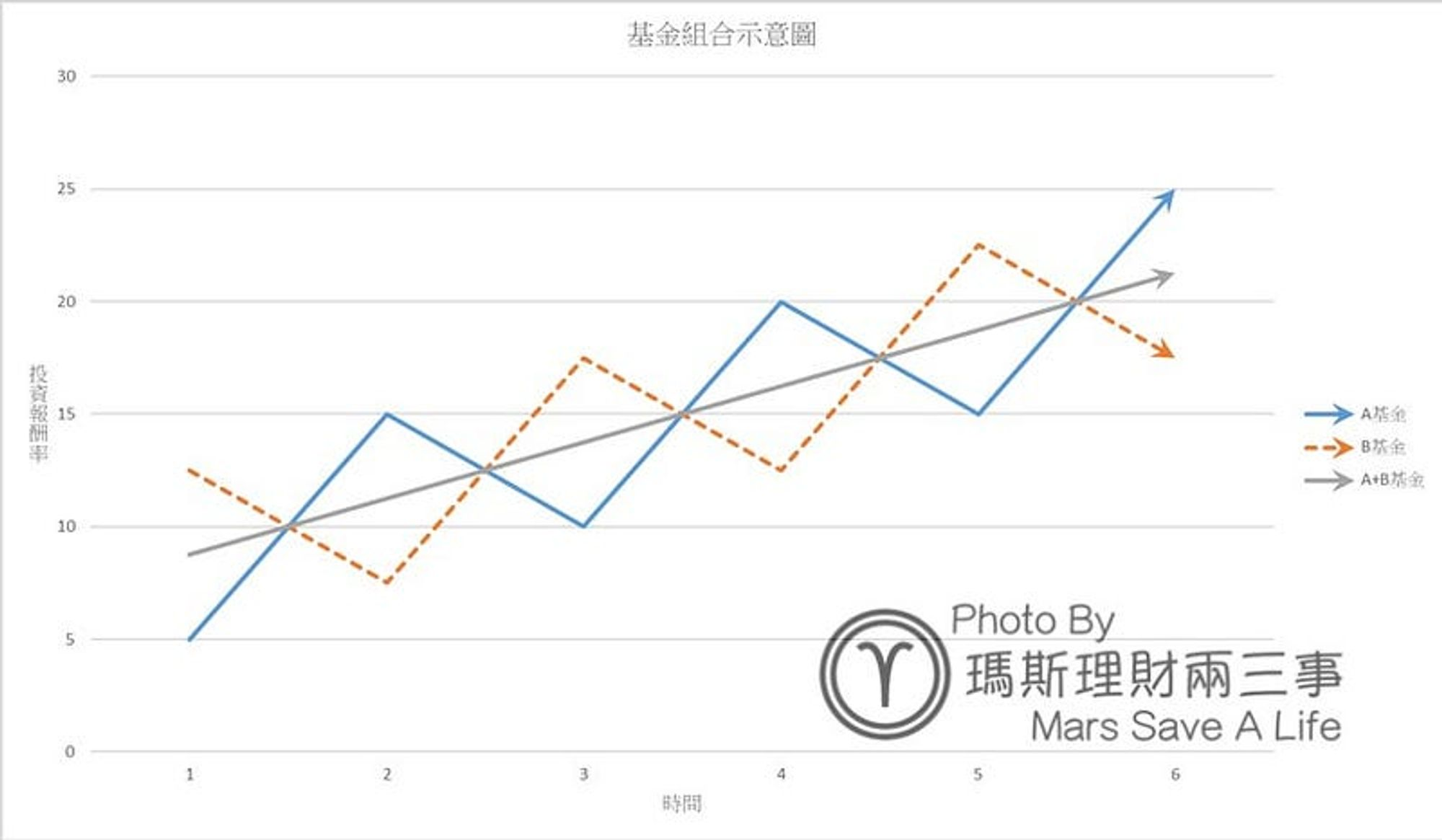
The main purpose of “diversified investment” is to be able to balance through negatively correlated investment targets. There will still be negatively correlated industries among a basket of stocks. For example, air conditioner stocks and heater stocks are negatively correlated industries. Therefore, in Figure 1, investing in Fund A and Fund B respectively, investing in both will achieve the effect of balancing risk between Fund A and Fund B in the figure. If other tools also have this type of characteristic, then they can also be used as targets for diversified investment.
Principle 2: Reduce Risk
“Reduce risk” takes funds as an example, which is to control risk through the ratio of equity funds and bond funds. Equity funds have high risk and high returns, while bond funds are the opposite, with low risk and low returns. Therefore, they are often used as investment portfolios for asset allocation.
Assuming that the annualized return of a certain global fund is 15% and the standard deviation is 15%, and the annualized return of another bond fund is 4% and the standard deviation is 5%. After investing NT$500,000 (about USD$15,000) in equity funds and NT$500,000 (about USD$15,000) in bond funds for asset allocation, although the rate of return drops to 9.5%, the standard deviation of the new portfolio also decreases to 10%. This shows that asset allocation can indeed achieve the purpose of “reducing risk”.
Rebalancing
Asset rebalancing refers to adjusting the proportion of the investment portfolio back to the original preset proportion of each asset. During the investment process, the proportion of the investment portfolio will change with market fluctuations, and this change will cause the original investment settings to deviate from the original settings. For example, if your original investment portfolio was 60% stocks and 40% bonds, but in the case of a stock market rise, the stock ratio may rise to 70% and the bond ratio may fall to 30%.
The purpose of rebalancing is to control risk and keep the investment portfolio at a proportion that suits you. If the proportion of stocks in the investment portfolio is too high, it will increase risk; if the proportion of bonds in the investment portfolio is too high, it will reduce returns.
Rebalancing can be done in the following ways:
- Sell assets that have risen and buy assets that have fallen.
- Reallocate the assets in the investment portfolio to the original proportion.
- Use the automatic rebalancing function.
The frequency of rebalancing can vary depending on individual circumstances. Generally speaking, it is recommended to rebalance quarterly or semi-annually. If your investment portfolio has more asset classes, or your investment goals are more conservative, you may consider rebalancing monthly.
Benefits of Rebalancing
- Can help control risk.
- Can increase the return of the investment portfolio.
- Can reduce the psychological cost of investment.
Disadvantages of Rebalancing
- May generate transaction costs.
- Requires regular inspection of the investment portfolio.
All in all, rebalancing is an effective investment strategy that can help investors control risk, increase returns, and reduce the psychological cost of investment.
Info
💡 Want to learn more about VOO investment strategies? Visit the VOO Investment Knowledge Center
Further Reading
懶得變有錢 (Lazy to be Rich)’s Conclusion

The key to asset allocation is to diversify investment and reduce risk. Before deciding on asset allocation, you must first consider your life goals. Asset allocation can be achieved through the proportion of investment tools, such as a combination of global equity ETFs and global bond ETFs. Rebalancing is an important strategy for controlling risk and maintaining the proportion of the investment portfolio. It can be achieved by selling assets that have risen, buying assets that have fallen, or reallocating assets. Rebalancing can help investors control risk, increase returns, and reduce psychological costs.
The core is still to control the risk of your assets and ensure that the financial goals to be achieved can be completed.
🚀 已有 1,000+ 讀者加入理財成長之路