
VOO 2026 Complete Analysis: Key Differences from SPY, Fees & Performance Comparison
In this article, you'll learn:
Hey everyone! Today I want to talk about VOO, particularly for those of us who care about financial planning — is VOO really worth investing in? What exactly is VOO?
Simply put, it’s Vanguard’s fund tracking the S&P 500 index — you buy into America’s large-cap companies all at once. So heading into 2026, is VOO still worth investing in? Let’s look at the “verifiable data.”
Info
💡 Want to systematically learn about VOO investing? Visit the VOO Investing Knowledge Hub for complete resources from beginner to advanced!
What Is VOO? Why Do I Pay Attention to It?
VOO’s full name is the Vanguard S&P 500 ETF. As the name suggests, it follows the S&P 500 — holding tech giants like Apple and Microsoft alongside everyday consumer goods companies that make toothpaste and cola. What makes VOO so attractive is its ultra-low expense ratio of just 0.03% — to put that in perspective, if you invest NT$10,000, you only pay NT$3 in annual management fees. That’s a bargain! For someone like me who’s saving for retirement, adding VOO to my portfolio is both solid and stress-free.
For a detailed comparison of QQQ and VOO, check out this updated analysis:
https://lazytoberich.com.tw/blog/investment-comparison-of-the-2024-annual-returns-of-0050-voo-and-qqq-why-is-there-such-a-big-difference/
VOO’s Key Features
- Low Cost: Only 0.03% management fee
- Risk Diversification: Invest in 500 companies at once
- Automatic Reinvestment: Dividends automatically reinvested — tax-efficient and hassle-free
- Tracks the Market: Follows the S&P 500 index for steady growth
How Has VOO Been Performing Lately? Is It Worth Buying?
Based on official and market data through 2026-01-31, the S&P 500 still delivered double-digit returns in 2025, and VOO as a low-cost tracking ETF typically performs extremely close to the index itself. The point of these products isn’t a short-term explosion — it’s “low cost + long-term holding.”
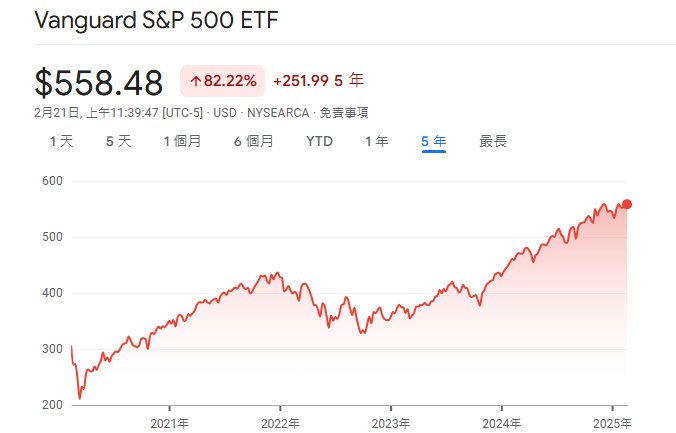
If your strategy is dollar-cost averaging (DCA) and long-term holding, VOO’s position remains very clear: participate in U.S. large-cap growth at the lowest possible intervention cost.
How Is the U.S. Economy? What Does That Mean for VOO?
Looking at the latest publicly available data, the U.S. macro environment — while no longer ultra-loose — is still in “growing, inflation easing” territory: the latest available GDP reading is annualized +4.4% for 2025 Q3; January 2026 CPI year-over-year was 2.4%; and the Fed maintained its policy rate at 3.50%–3.75% at the January 28, 2026 FOMC meeting.
Key Economic Indicators at a Glance
| Indicator | Latest Data |
|---|---|
| GDP Growth Rate | 4.4% (2025 Q3, BEA) |
| Inflation (CPI) | 2.4% (January 2026, BLS) |
| Policy Rate | 3.50%–3.75% (FOMC, 2026-01-28) |
Strong Corporate Earnings Benefit VOO
Corporate profitability remains a key variable supporting the market. For investors, the key isn’t predicting which company beats expectations every quarter — it’s confirming whether you can accept the volatility of an index ETF and continue investing consistently.
Strong corporate earnings boost market confidence, driving stock prices higher, and VOO as an S&P 500 tracking fund naturally benefits too. Choosing VOO makes building wealth simple and enjoyable!
VOO or SPY? Which One to Pick?
When it comes to S&P 500 ETFs, SPY is another popular option. Here are the core differences investors most commonly compare:
VOO vs. SPY Comparison Table
| Feature | VOO | SPY |
|---|---|---|
| Expense Ratio | 0.03% | 0.09% |
| 1-Year Return (reference) | ~17.8% (2025) | 19.67% (through 2026-01-31) |
| Positioning | Long-term holding cost advantage | Mature liquidity and trading ecosystem |
As shown, VOO still has a cost advantage; SPY, with its higher trading volume, is more suitable for short-term traders or those who need high liquidity. If your goal is long-term accumulation, VOO remains one of the mainstream choices.
Where Does VOO Shine in Financial Planning?
In financial planning, VOO’s advantages are obvious. Here are the main reasons:
- Low Cost: Only 0.03% annual management fee — more money stays in your pocket.
- Risk Diversification: Investing in 500 companies reduces single-stock risk.
- Automation: Dividends automatically reinvested — no manual action needed.
- Long-Term Growth: Follows U.S. economic growth for steady appreciation.
For anyone who wants easy money management, VOO is a stress-free and cost-efficient tool — especially suitable for building a retirement fund or an education fund.

2026 Outlook: Is VOO Still Worth Investing In?
Overall, VOO’s investment logic hasn’t changed heading into 2026: you’re not betting on a single company — you’re buying into the overall earnings power of U.S. large-cap stocks. Even if there’s short-term volatility, as long as your capital plan is sound, VOO remains a core ETF you can consistently execute.
*Chart Description: Imagine a pie chart showing the S&P 500 sector distribution — for example, tech at 30%, financials at 15%, etc. This chart can be placed after this section to help readers understand VOO’s investment diversity.*
For those with financial planning needs, investing some of your money in VOO right now shouldn’t disappoint you. Of course, investing carries risk, but personally I’m very bullish on VOO’s future!
Further Reading
Lazy Da’s Wrap-Up

🚀 已有 1,000+ 讀者加入理財成長之路
Data Updates & Sources (as of 2026-01-31)
- VOO official product page (expense ratio):
https://investor.vanguard.com/investment-products/etfs/profile/voo - SPY official fund page (1-year/10-year performance, as of 2026-01-31):
https://www.ssga.com/us/en/intermediary/etfs/spdr-sp-500-etf-trust-spy - U.S. policy rate (FOMC, 2026-01-28):
https://www.federalreserve.gov/newsevents/pressreleases/monetary20260128a.htm - U.S. CPI (January 2026, published 2026-02-13):
https://www.bls.gov/cpi/ - U.S. GDP (latest published: 2025 Q3):
https://www.bea.gov/data/gdp/gross-domestic-product - VOO total return reference (platform aggregate):
https://www.financecharts.com/etfs/VOO/performance/total-return
📚 More VOO Investing Knowledge: Back to VOO Investing Knowledge Hub
Explore complete VOO investing tutorials and strategy analysis