
VOO 2025 Complete Analysis: 5 Key Differences vs. SPY, Full Fee and Performance Comparison
In this article, you'll learn:
Hey, fellow lazy investors! Today I want to talk about VOO — especially whether it’s worth investing in for those of us who care deeply about financial planning. So what exactly is VOO?
Simply put, it’s a fund launched by Vanguard that tracks the S&P 500 index, giving you exposure to the 500 largest companies in the United States all at once. Sounds impressive, right? But with 2025 just getting started, is VOO still worth investing in? Let me share my thoughts.
Info
💡 Want to learn VOO investing systematically? Visit the VOO Investment Knowledge Center for complete investment resources from beginner to advanced!
What Is VOO, and Why Do I Follow It?
VOO, officially the Vanguard S&P 500 ETF, moves in line with the S&P 500 — it holds tech giants like Apple and Microsoft, alongside everyday consumer goods companies that make toothpaste and Coke. What makes VOO most attractive is its ultra-low expense ratio of just 0.03% — to put that in perspective, if you invest NT$10,000, you’re only paying NT$3 a year in management fees. What a deal! For someone like me looking to build a retirement nest egg, adding VOO to my portfolio feels both solid and low-maintenance.
Want a detailed comparison of QQQ vs. VOO? I’ve written a separate in-depth article analyzing the differences between the two.
Key Features of VOO
- Low cost: Just 0.03% annual expense ratio
- Diversification: Exposure to 500 companies in a single investment
- Automatic reinvestment: Dividends are automatically reinvested — tax-efficient and hassle-free
- Market-aligned growth: Tracks the S&P 500 for steady, long-term appreciation
How Has VOO Been Performing Lately? Is It Worth Buying?
As of February 21, 2025, VOO is priced at approximately $559.01 USD, performing quite steadily. While there hasn’t been much major news recently, the S&P 500 has been performing well overall, lifted by economic recovery and strong corporate earnings. VOO has been riding that wave nicely.
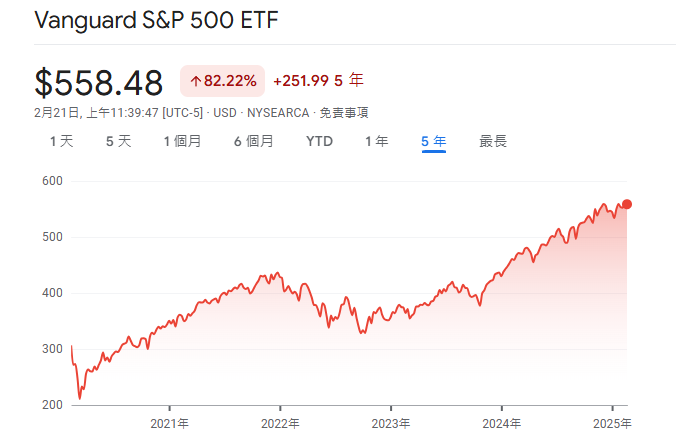
Data shows the market has continued climbing into early 2025, and passive funds like VOO have been steadily capturing those gains. For lazy investors, VOO really does take the work out of investing.
How Is the US Economy Doing? What Does It Mean for VOO?
I did a bit of research on the economic data: US GDP grew 2.3% in Q4 2024 — not spectacular, but solid and stable, with both consumer and government spending on the rise. As for inflation, January 2025 came in at 3% — slightly above the Federal Reserve’s (聯準會, the US central bank) target, but far calmer than the wild swings of previous years. With a stable economy and strong corporate earnings, VOO — which follows the market closely — naturally performs well. Investing in VOO seems like a smart move.
Key Economic Indicators at a Glance
| Indicator | Latest Data |
|---|---|
| GDP Growth Rate | 2.3% (Q4 2024) |
| Inflation Rate | 3% (January 2025) |
Strong Earnings Reports — VOO Benefits Too
The earnings data is even more encouraging. In Q4 2024, 77% of S&P 500 companies had reported earnings, with 78% beating expectations — better than the past 5-year average.
This signals strong corporate profitability, boosted market confidence, and rising stock prices. As a fund tracking the S&P 500, VOO naturally benefits from all of this. Choosing VOO makes growing your money simple and even enjoyable!
VOO or SPY? Which Should You Pick?
When it comes to S&P 500 ETFs, SPY is another popular option. Here’s a quick comparison of fees between VOO and SPY:
VOO vs. SPY Comparison
| Feature | VOO | SPY |
|---|---|---|
| Expense Ratio | 0.03% | 0.09% |
As illustrated, VOO has a lower expense ratio, and its dividends can be automatically reinvested, making it more cost-efficient and hands-off in the long run. While SPY also performs well, a lazy investor like me prefers VOO — it’s cheaper and easier. The ideal choice, really.
Where Does VOO Fit in Financial Planning?
In terms of financial planning, VOO’s advantages are clear. Here are the main reasons:
- Low cost: Just 0.03% annual management fee, saving you more money.
- Risk diversification: Investing across 500 companies reduces single-stock risk.
- Automation: Dividends automatically reinvest — no manual work needed.
- Long-term growth: Rides along with growth of the US economy for steady, compounding returns.
For anyone who wants effortless investing, VOO is a low-maintenance powerhouse — especially well-suited for building retirement or education funds.

2025 Outlook — Is VOO Worth Investing In?
Looking at the big picture, VOO isn’t experiencing explosive growth right now, but a stable economy, controlled inflation, and improving corporate earnings all create a favorable environment for it. Market forecasts point to the S&P 500 continuing to rise, so VOO — as its representative fund — should continue to grow steadily as well.
*Chart description: Imagine a pie chart showing the sector breakdown of the S&P 500 — e.g., tech at 30%, financials at 15%, and so on. This chart can be placed after this paragraph to give readers a sense of VOO’s diversified exposure.*
If you have financial planning needs, investing some capital into VOO now probably won’t disappoint you. Of course, investing always carries risk — but personally, I’m very optimistic about VOO’s future!
Further Reading
“Lazy” Conclusion

🚀 已有 1,000+ 讀者加入理財成長之路
📚 More VOO investment knowledge: Back to the VOO Investment Knowledge Center Browse the full library of VOO investment guides and strategy analysis