Hold On Before Buying a House! Why Investing in ETFs is a Better Choice? A Comprehensive Analysis of Compound Interest and Liquidity
- 懶大 (Lazy Da)
- 財務工具與金融商品
- Last updated: September 12, 2023
- 2 min read
In this article, you'll learn:
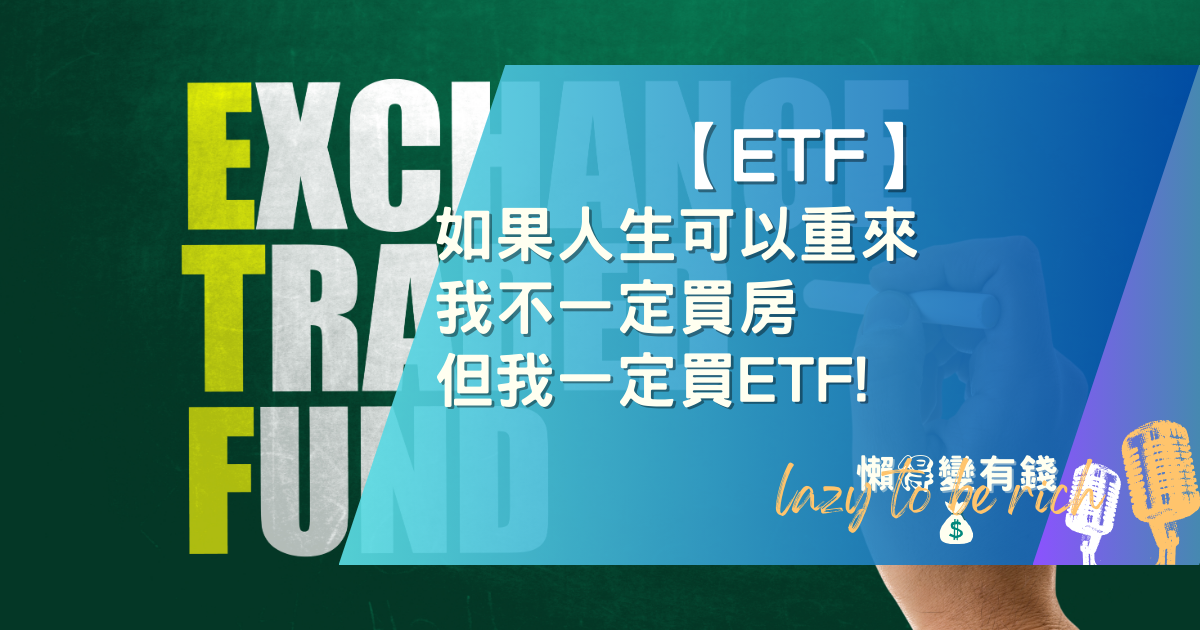
Many people face a common decision in life: whether to use their savings to buy a house or invest in stocks, bonds, or other financial instruments. There is no one-size-fits-all answer to this question, as everyone’s circumstances and goals are different. However, if life could be reversed, I am certain that I would not hesitate to increase my investment in exchange-traded funds (ETFs).
The Cost of Long-Term Investment is “Time”
The real cost of long-term investment is not money, but “time.” The importance of this lies in its ability to lay a solid foundation for future financial freedom and economic security. Here are some of the key reasons why I would choose to invest rather than devote most of my financial resources to buying a house.
The Magical Charm of Compound Interest
One of the biggest advantages of long-term investment is compound interest. Compound interest refers to the process of reinvesting earned interest or returns to earn even more interest or returns. This means that even with continuous investment of new funds, both old and new funds can continue to grow.
For example, suppose you invest a sum of money at the age of 30, and your investment grows at an average rate of 8% per year. In 9 years, you will have twice the amount of money you initially invested. This is because the returns earned are not only based on the initial investment but also on the returns earned previously. This compounding effect becomes more powerful over time, which is why long-term investors in ETFs typically achieve better investment results.
(The ETFs mentioned here do not include all ETFs that may contain dividend mechanisms that are no longer reinvested)
Diversify Risk with Diversified Investments
Investment also allows for better risk diversification. When funds are invested in different asset classes, such as stocks, bonds, real estate investment trusts (REITs), different countries, different industries, etc., it is also possible to further diversify the investment targets through ETFs. This can reduce the risk associated with a single investment. In contrast, if we devote most of our financial resources to buying a house, our risk will be highly concentrated in the real estate market. If the market declines, we may suffer significant losses. No one can be sure whether Taiwan will encounter a subprime mortgage crisis like the United States. And just one such event could wipe out all the money saved.
Liquidity and Flexibility
Investing in ETFs offers greater liquidity and flexibility. When you need funds, you can sell your investments relatively easily without having to wait for a buyer for your property. This is very important for the ability to cope with emergencies or opportunities. If you use all your funds to buy a house, the funds will be tied up in real estate and not easily accessible.
You might say, what if the market falls when I need funds? I will explain later in more articles how to avoid these potential problems through “financial planning”.
Buy a House When the Time is Right, Invest with Discipline
Although house prices in Taiwan have only risen in the past few years, house prices are not as stable as the long-term stock market, because houses are usually not one-time purchases, and are affected by factors such as loans, interest rates, and house prices. Therefore, if you are a young person, it is not recommended to directly invest in real estate for your first investment (if you have sufficient ability, sound financial planning, and the rigid demand for self-occupation may be considered an exception).
The most important thing in investing in financial products is mindset and discipline. Often, wanting to get returns in the short term makes it difficult to achieve long-term investment.
Furthermore, there is no ceiling on the price of stocks, but the housing market will always have an upper limit in our lifetime (I am referring to the upper limit in the median range, not the price ceiling in the prime locations of Taipei City).
Further Reading
懶得有結論 (Lazy Conclusion)

In conclusion, while buying a house is a valuable investment, it is not necessarily suitable for everyone. Long-term investment offers more opportunities to achieve financial goals through the compounding effect and risk diversification. If I could go back in time, I would pay more attention to investing in ETFs, as it provides more possibilities for achieving financial freedom and economic security.
Regardless of which method you choose, you should carefully consider your financial goals and develop a corresponding investment strategy. No matter which path you choose, I hope you succeed in your financial journey.
🚀 已有 1,000+ 讀者加入理財成長之路