QQQ ETF Complete Analysis (2024): Pros, Cons, Holdings & Fees Revealed
In this article, you'll learn:
Invesco QQQ Trust (Ticker: QQQ), Commonly Known as QQQ
QQQ Basic Information
| ETF Ticker | QQQ |
|---|---|
| ETF Full Name | Invesco QQQ Trust |
| Index Tracked | 100 largest non-financial companies listed on NASDAQ |
| Expense Ratio | 0.2% |
| Inception Date | 1999/03/10 |
| Investment Type | Broad Market Equities |
| Investment Region | United States |
| Top 5 Holdings | Microsoft / Apple / NVIDIA / Amazon / Broadcom |
| 10-Year Avg. Return | ~18.67% |
| 1-Year Return | 23.63% |
| Dividends | Yes (Mar/Jun/Sep/Dec) |
| Official Website | https://www.invesco.com/qqq-etf/en/about.html |
| Data last updated: Aug 2024 |
What Makes QQQ Special?
QQQ’s characteristics can be analyzed through its stock selection strategy, holdings composition, and investment risks. QQQ is already a household name among U.S. stock investors — especially if you’re a believer in tech stocks, you definitely know it. But if you searched your way here, you might be a beginner investor, so let’s break it down simply through selection strategy, holdings composition, and investment risk.
Stock Selection Strategy
QQQ tracks the NASDAQ-100 Index, which covers the 100 largest non-financial companies listed on the NASDAQ exchange, weighted by market capitalization. In other words, the larger a company’s market cap, the higher its weight in QQQ.
Holdings Composition
QQQ’s holdings are primarily concentrated in technology, communication services, and consumer discretionary sectors. According to July 2024 data, the technology sector accounts for over 50%. The top ten holdings include major tech companies like Microsoft, Apple, NVIDIA, and Amazon.
| Holdings | Allocation |
|---|---|
| Apple Inc | 9.12% |
| Microsoft Corp | 8.31% |
| NVIDIA Corp | 7.79% |
| Broadcom Inc | 5.06% |
| Meta Platforms Inc Class A | 4.93% |
| Amazon.com Inc | 4.75% |
| Costco Wholesale Corp | 2.65% |
| Tesla Inc | 2.61% |
| Alphabet Inc Class A | 2.53% |
| Alphabet Inc Class C | 2.44% |
| Top 10 Holdings weight | 50.19% |
QQQ Pros and Cons
Pros
- High Tech Growth Potential: Most holdings are high-growth tech companies. Just look at the top 5 holdings and you’ll know exactly what this ETF is about.
- One-Stop Access to U.S. Tech Giants: The upside is that QQQ lets you invest in multiple major U.S. tech companies at once. When Apple drops, NVIDIA might go up — there’s still a tiny bit of diversification. But it’s quite limited.
- Low ETF Investment Costs: Compared to traditional mutual funds, ETFs have lower management fees. The 0.2% management fee is roughly in the mid-range.
Cons
- High Volatility: Tech stocks generally don’t have low volatility — once you’re on the ride, it’s like a roller coaster. But I remember in Naruto, there’s a line describing Naruto that goes something like: “The more unstable the ninja, the greater their growth potential.” Yep — that’s QQQ.
- Concentration Risk: The portfolio is concentrated in the tech sector. Sure, it’s diversified across 100 tech companies, but think of it this way: if you have 10 goldfish, those 10 are still goldfish — none of them can stick to the tank wall and clean it for you. That’s what over-concentration of risk looks like.
Investing in QQQ is suitable for investors who are bullish on the tech sector and can tolerate higher risk. Before investing, do your homework, assess your own risk tolerance, and choose an appropriate strategy such as dollar-cost averaging or long-term holding.
QQQ Tracking Error
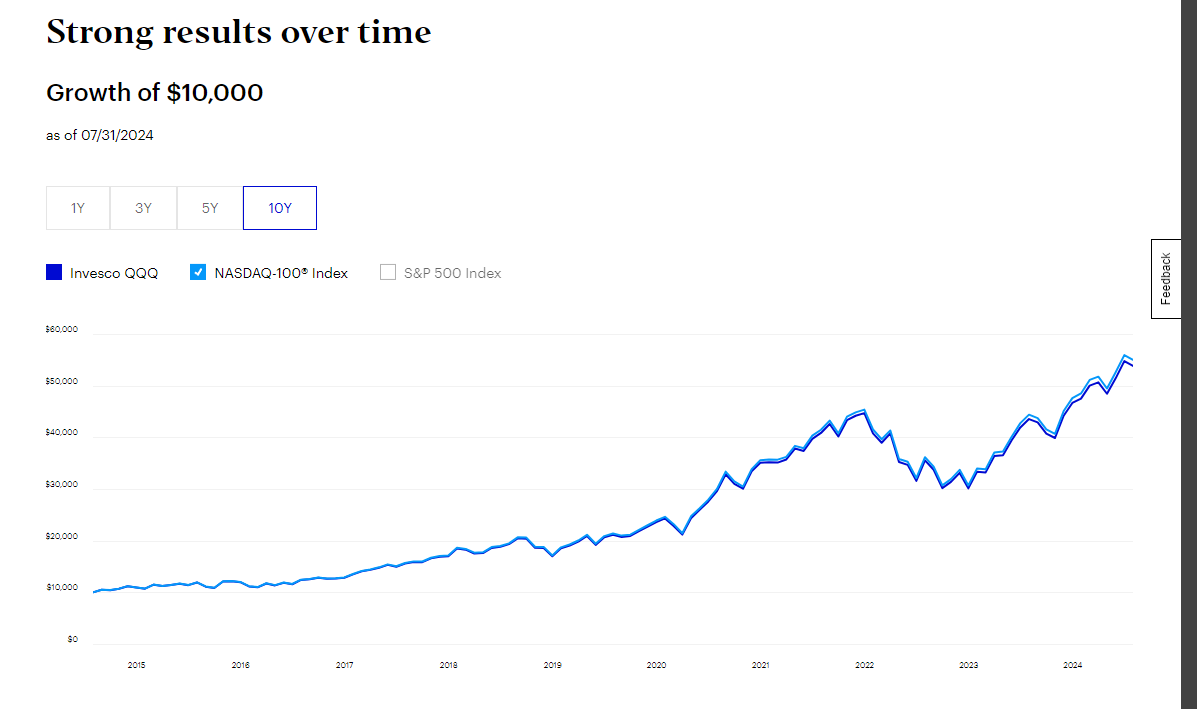
As you can see from the chart, QQQ’s tracking error is extremely small — it practically hugs the Nasdaq-100. Given the 0.2% expense ratio, this is an acceptable level of tracking error.
QQQ Cumulative Return Performance
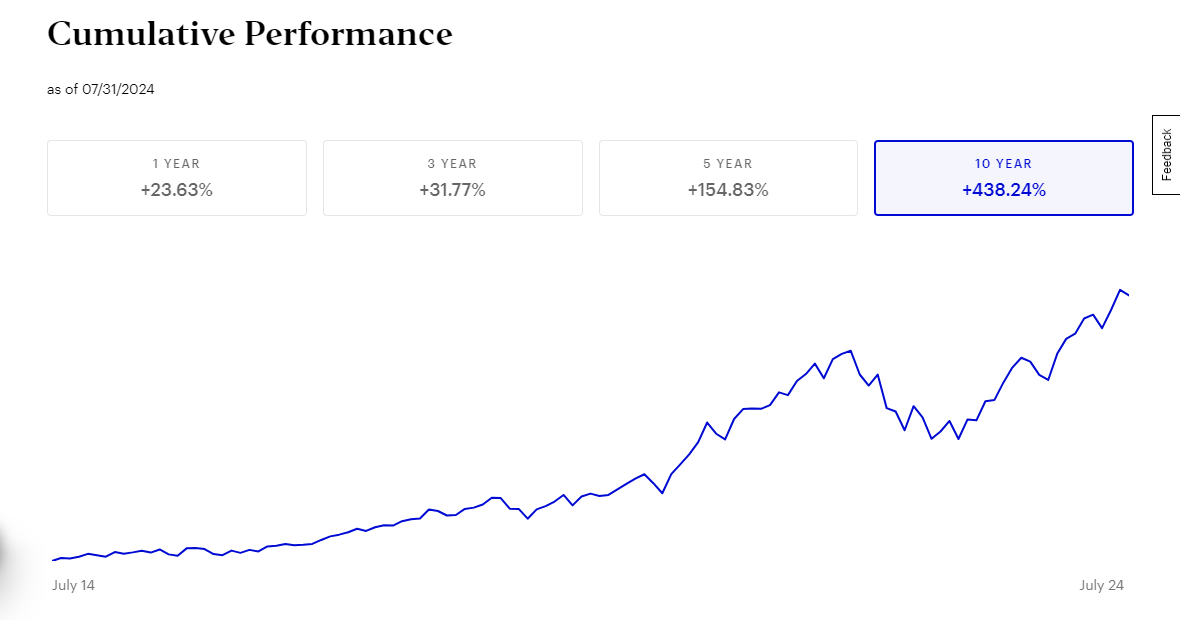
| Return Type | Past 1 Year | Past 3 Years | Past 5 Years | Past 10 Years |
|---|---|---|---|---|
| Annualized Return | 30.48% | 11.27% | 21.52% | 18.67% |
While the annualized returns look impressive, don’t forget this is a highly sector-concentrated ETF. When the tech sector as a whole takes a dive, every company in it goes down together.
What Type of Investor Is QQQ Suitable For?
Invesco QQQ Trust (QQQ) primarily tracks the NASDAQ-100 Index, covering the 100 largest non-financial companies in the U.S., especially tech companies. This makes QQQ suitable for investors who are bullish on the tech sector and can handle higher risk, since its holdings are concentrated in high-growth tech, communication services, and consumer discretionary sectors. Simply put, if you’re a tech enthusiast, you might be a good fit for QQQ — but being a gadget lover doesn’t necessarily mean you can stomach larger drawdowns. Be careful.
However, investing in QQQ carries relatively higher risk because these tech stocks are susceptible to market sentiment and industry shifts, leading to greater volatility. While everything today seems inseparable from “technology,” being overly concentrated in a specific sector is still a form of high risk.
In summary, QQQ is suitable for investors who are confident in the tech sector, can tolerate high volatility, and are seeking high growth potential — not for conservative investors with lower risk tolerance.
If possible, extend your investment horizon to help increase your risk tolerance.
How to Buy QQQ?
In a previous article, Long-Term Investing in U.S. Stocks: Sub-Brokerage vs. Overseas Brokerages, I mentioned that some people pursue the ultimate cost reduction to maximize future returns. But when you spend a lot of time and effort reducing investment costs, that’s not necessarily the best choice.
Because the investment landscape and technology have been evolving rapidly in recent years, using a domestic sub-brokerage (複委託, a system in Taiwan where local brokers execute trades on foreign exchanges on your behalf) is now very convenient and eliminates many risks associated with opening accounts at overseas brokerages. The cost is slightly higher, but think of it as buying insurance for your money — so you don’t invest for years only to have your money stuck overseas.
Info
Would QQQ Be Used as an Investment Vehicle in Financial Planning?
When it comes to financial planning, the chance of selecting QQQ as an investment vehicle is, honestly, not that high. QQQ tracks the NASDAQ-100 Index, primarily covering large tech companies, and while it has great growth potential with excellent returns over the past 10 years, its high volatility and concentration in tech stocks are factors that can’t be ignored.
While I wouldn’t use QQQ as a primary investment vehicle directly, it’s not out of the question as part of an asset allocation strategy — it all depends on each person’s unique financial DNA.
Warning
Investing involves risk. Past performance does not guarantee future results. Before making any investment decisions, please thoroughly understand the relevant risks and carefully evaluate based on your own financial situation and risk tolerance.
Further Reading
Lazy Da’s Conclusion

🚀 已有 1,000+ 讀者加入理財成長之路