財務規劃與心態
38-Year-Old Engineer with NT$30K Extra Monthly: Pay Off Mortgage or Buy ETFs? A Real Case Study
A 38-year-old engineer earning NT$70K/month has NT$25K extra and can't …
2026-03-09
5 分鐘 →
Info
💡 Want to learn more about VOO investment strategies? Visit the VOO Investment Knowledge Center
It looks like there are only two options, but it’s actually a complex question. “Better” is relative — if you’re comparing dollar-cost averaging (DCA) versus lump-sum investing to see which is better, let me give you the answer upfront:
Tip
Lump-sum investing is the best, fastest, most hassle-free, and most efficient approach
If your investment target has an annualized return of 8%, and you have NT$1,000,000 on hand, is it better to invest it all at once or split it into 100 installments? Remember, the assumption here is that you already have the NT$1,000,000.
Let’s first compare lump-sum investing with dollar-cost averaging, and then we’ll discuss how to invest.
| Investment Method | Amount After 8 Years (Month 100) |
|---|---|
| Lump-sum NT$1,000,000 | Approx. NT$1,851,339 |
| Dollar-cost averaging | Approx. NT$1,570,357 |
Whether or not you know how to use a financial calculator, you can also plug the same conditions into an AI — the result will always show lump-sum investing beating dollar-cost averaging. Now that we know that with enough time, lump-sum investing significantly outperforms DCA, the next question is: how do you invest with peace of mind?
When you put the full NT$1,000,000 in, it immediately starts generating annualized returns. But if you split NT$1,000,000 into 100 installments, after 10 installments, 90 portions of your capital are still sitting idle. Of course the final amount from lump-sum investing will be higher. This is mainly because lump-sum investing has the full amount earning compound interest from day one, whereas dollar-cost averaging invests gradually, so the compounding effect is smaller in the early stages.
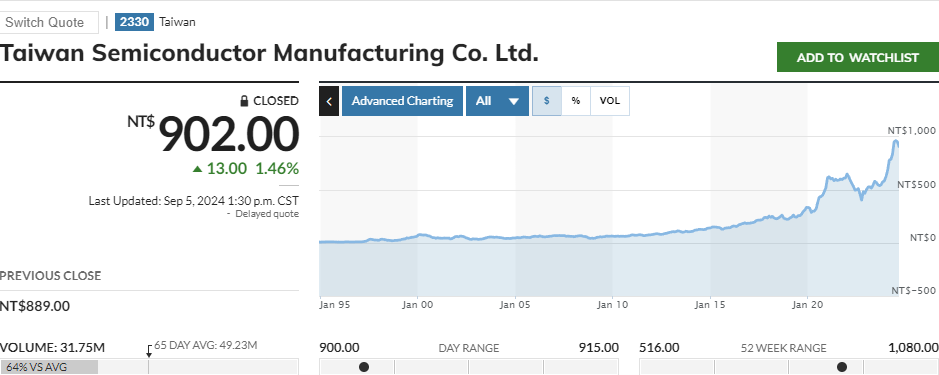
If you have a few hundred thousand NT$ and want to invest in individual stocks, think very carefully. No one can guarantee the stock you pick will be the next TSMC (Taiwan Semiconductor Manufacturing Company). This strongest Taiwanese stock has had a remarkable 30-year run, but we can’t predict the next 30 years. What if the industry shifts and technology more advanced than semiconductors emerges? Then you’d be gambling on whether the company can successfully pivot.
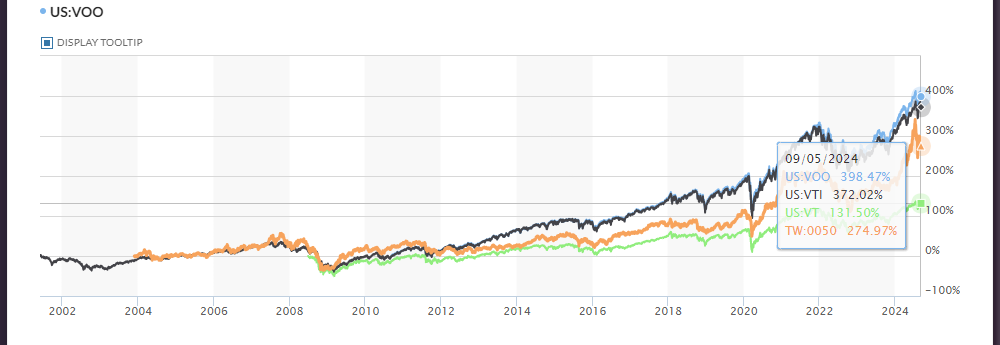
So how do you achieve diversified investing? You can refer to Affordable ETF 0050 vs. Luxury ETF VOO: Which Is Better for Your Long-Term Investment? for the concept. It’s not about whether 0050 or VOO is better — it’s about which one is more diversified.
In Taiwan, besides 0050, there aren’t many comprehensive ETFs, so let’s use 0050 for our discussion. For more comprehensive U.S. stock ETFs, let’s look at their holdings:
| ETF | Companies Held | Description |
|---|---|---|
| VOO (Vanguard S&P 500 ETF) | 503 companies | Tracks the S&P 500 index, representing the 500 largest U.S. companies by market cap. Slightly more than 500 because some companies like Alphabet have multiple share classes. |
| VTI (Vanguard Total Stock Market ETF) | ~3,800 companies | Tracks the entire U.S. stock market, covering all listed companies from large-cap blue chips to small enterprises. |
| VT (Vanguard Total World Stock ETF) | ~9,700 companies | Tracks the global stock market, including companies from developed and emerging markets — extremely broad coverage. |
| 0050 (Yuanta Taiwan 50 ETF) | 50 companies | Tracks only the top 50 companies in Taiwan by market cap. |
From this table, it’s clear that if I had a lump sum to invest, the most reassuring choice would be VT, because it spreads my capital across every market in the world, tracking the growth of about 10,000 companies globally.
The second factor to consider for lump-sum investing is time. As long as time is on your side, the market will continue to grow, and profits will persist. In theory, 10 years or more is a great investment timeframe.
2000–2024 Performance Chart: VOO/VTI/VT/0050 — Four ETFs
Here are the annualized returns for VOO, VTI, and VT since their inception (as of 2023):
| ETF | Inception Date | Annualized Return | Value After 10 Years |
|---|---|---|---|
| VOO (Vanguard S&P 500 ETF) | Sep. 7, 2010 | ~13.65% | NT$3,590,000 |
| VTI (Vanguard Total Stock Market ETF) | May 24, 2001 | ~8.80% | NT$2,320,000 |
| VT (Vanguard Total World Stock ETF) | Jun. 24, 2008 | ~6.60% | NT$1,890,000 |
| 0050 (Yuanta Taiwan 50 ETF) | Jun. 25, 2003 | ~10.09% | NT$2,610,000 |
🔒 免費訂閱,隨時可退訂
📩 訂閱即送 · Lead Magnet
訂閱即送 「ETF 懶人投資工具包」(VT/VOO/QQQ/0050 速查表、投資前檢查清單、定期定額紀律表)。有值得講的才寄 · 隨時退訂。