財務規劃與心態
38-Year-Old Engineer with NT$30K Extra Monthly: Pay Off Mortgage or Buy ETFs? A Real Case Study
A 38-year-old engineer earning NT$70K/month has NT$25K extra and can't …
2026-03-09
5 分鐘 →
Recently I’ve been helping an elderly client sort out estate tax. Their insurance eligibility age is about to hit the limit, and they want to get the right policy in place while they still can.
Many elderly parents react to estate tax (遺產稅) the same way: “It can’t be that much, right? Worst case, I’ll just transfer the house to the kids early.”
That sentence is half right and half very wrong. The right half: most families fall within the exemption plus deductions, so their estate tax really is zero. The wrong half: “transfer it to the kids early” isn’t a tax shortcut. It hands over control ahead of time, and you can only give away NT$2.44 million a year.
I said on EP76 that estate tax gets solved with a bit of tax planning and an insurance policy, so don’t overcomplicate it. This post breaks down the “planning” part for you: calculate first, then buy.
Data in this article is current as of 2026-10-01, based on Taiwan’s Estate and Gift Tax Act (遺產及贈與稅法) and Ministry of Finance announcements for ROC year 115 (2026). If the law changes, follow the latest announcement.
Estate tax isn’t about how much money your family has. It’s about what’s left after subtracting the exemption and deductions from the gross estate. If nothing is left, you owe nothing.
So every family has its own line. Using 2026 figures, here’s what it looks like for common family types:
| Family type (all children are adults) | Exemption + deductions | Estate below this line |
|---|---|---|
| No spouse, 1 child | NT$15.27 million | Estate tax: NT$0 |
| No spouse, 2 children | NT$15.83 million | Estate tax: NT$0 |
| Spouse, 1 child | NT$20.80 million | Estate tax: NT$0 |
| Spouse, 2 children | NT$21.36 million | Estate tax: NT$0 |
How it’s calculated: the NT$13.33 million exemption, plus NT$1.38 million for funeral expenses, NT$5.53 million for a spouse, and NT$560,000 for each adult child. If parents are still alive, or there are minor children or family members with severe disabilities, the deductions are even higher.
Going over the line isn’t a reason to panic either. The first NT$56.21 million of the net taxable estate is taxed at 10%, so every extra NT$1 million above the line costs NT$100,000 more.
Two things to keep in mind before you calculate:
If your family is clearly below the line, you can stop reading here. A perk for the lazy.
If you’re above the line, or close to it, keep reading. Financial planning starts with taking stock of where you are anyway (the 6 steps of financial planning), and estate tax is just one of the sheets.
| Net taxable estate | Tax rate | Progressive deduction |
|---|---|---|
| Up to NT$56.21 million | 10% | 0 |
| NT$56.21 million – NT$112.42 million | 15% | NT$2.8105 million |
| Over NT$112.42 million | 20% | NT$8.4315 million |
Common deductions: NT$5.53 million for a spouse, NT$560,000 for each adult child (minors get another NT$560,000 for each year until adulthood), NT$1.38 million for each parent, NT$1.38 million for funeral expenses, an additional NT$6.93 million per person with a severe disability, plus debts such as unpaid loans. Note that heirs who renounce their inheritance can’t claim these deductions.
What counts: houses and land, deposits (including foreign currency), stocks, funds, and ETFs, overseas accounts and property, money lent to others, and gold, jewelry, and collectibles.
Three things are most often overlooked:
What doesn’t count: Article 16 of the Estate and Gift Tax Act lists 13 categories. The ones most relevant to ordinary families are assets donated to the government or charities, everyday household items up to NT$1 million, work tools up to NT$560,000, and life insurance payouts to a designated beneficiary.
For an insurance payout to stay out of the estate, all three conditions must be met:
Here’s an illustrative family: a mother with no spouse and one son, with an estate of NT$90 million (taxable value): NT$60 million in property, NT$25 million in stocks, and NT$5 million in deposits.
After subtracting NT$15.27 million, the net taxable estate is NT$74.73 million, which falls in the 15% bracket: NT$74.73 million × 15% − NT$2.8105 million = NT$8.399 million.
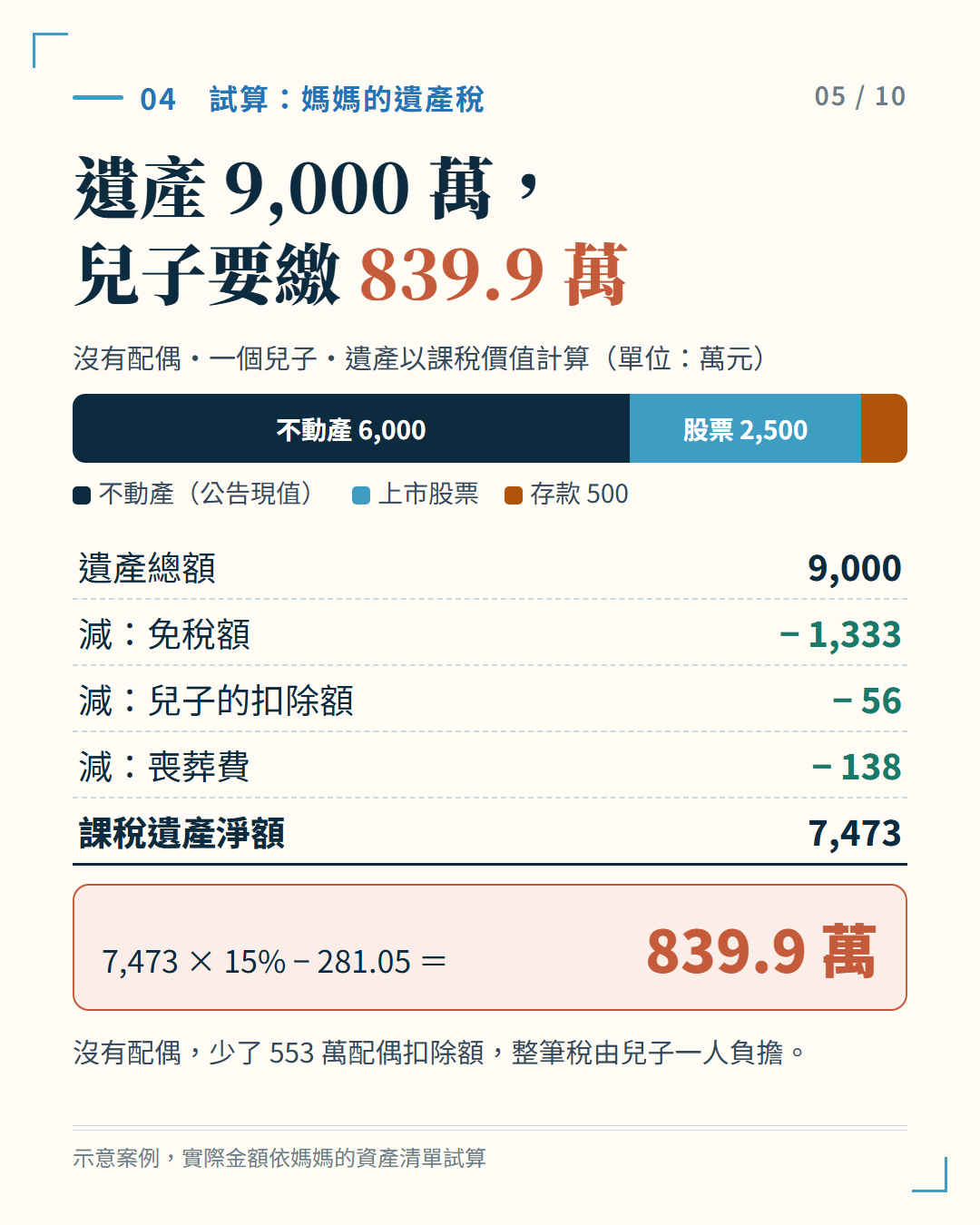
Illustrative case: deductions total NT$15.27 million; estate tax NT$8.399 million
The problem isn’t just how much tax. It’s where the money is.
Article 8 of the Estate and Gift Tax Act says that until the estate tax is paid, the estate can’t be divided or transferred. With only NT$5 million in deposits, NT$3.399 million is still missing, and the house and stocks are stuck and can’t be sold. The son’s remaining options: pay out of pocket or borrow, apply for installments (with interest), or pay with the property itself (valued at the announced value, which is less than market value). Paying late also brings a surcharge of 1% for every 3 days, up to 10%.
If the mother had set aside the tax money with a policy (illustrative: the mother is both policyholder and insured, the son is the beneficiary, total premiums of NT$7.5 million, death benefit of NT$10 million):
| Item | No reserve | With reserve |
|---|---|---|
| Gross estate | NT$90 million | NT$82.5 million (premiums moved out of the estate) |
| Estate tax | NT$8.399 million | NT$7.274 million |
| Money for the tax | NT$5 million in deposits, NT$3.399 million short | NT$10 million payout, arrives in about 15 days |
| What the son ends up with | NT$81.601 million | NT$85.226 million |
The son ends up with NT$3.625 million more, from two sources: the NT$2.5 million by which the payout exceeds the premiums, plus NT$1.125 million less tax because the premiums left the estate. Even if the tax bureau decides to add the payout back into the estate, the tax becomes NT$8.774 million, and the NT$10 million payout still covers it.
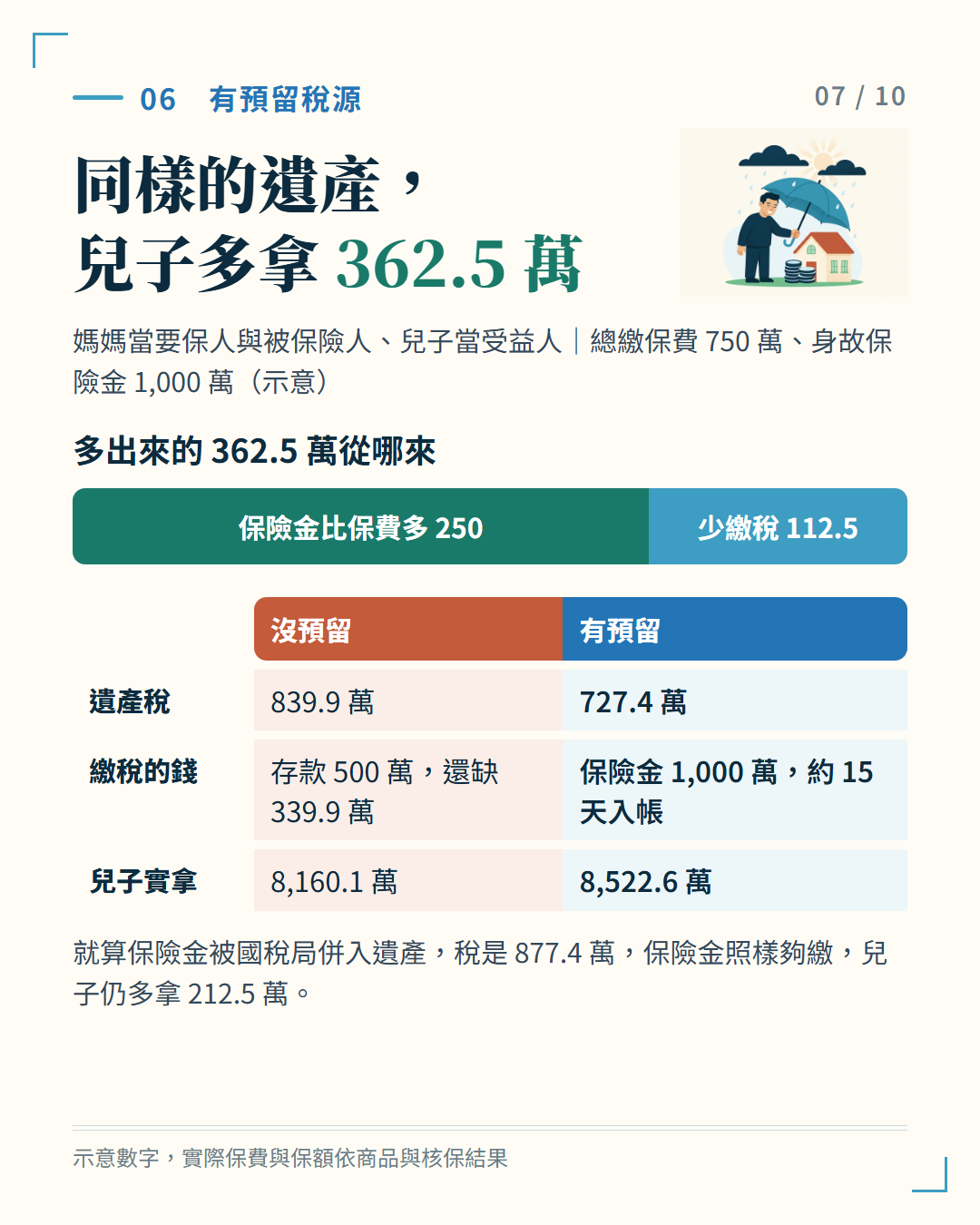
Same estate: with a tax reserve, the son gets NT$3.625 million more (illustrative figures)
The payout can be used for the tax this quickly because it goes straight to the beneficiary, without waiting for the estate to be divided. Article 34 of the Insurance Act says that if no deadline is agreed, the insurer must pay within 15 days of notification.
Back to that line at the start: “transfer the house to the kids early.” Gifting isn’t off the table, but parents should know three things first:
Insurance works the other way around. When the mother is the policyholder herself, the policy is her property: while she’s alive she can change the beneficiary, borrow against the policy, and cancel it if needed. The son is only the beneficiary and can’t touch the money while she’s alive; only when the day comes does the payout turn directly into cash for the son to pay the tax.
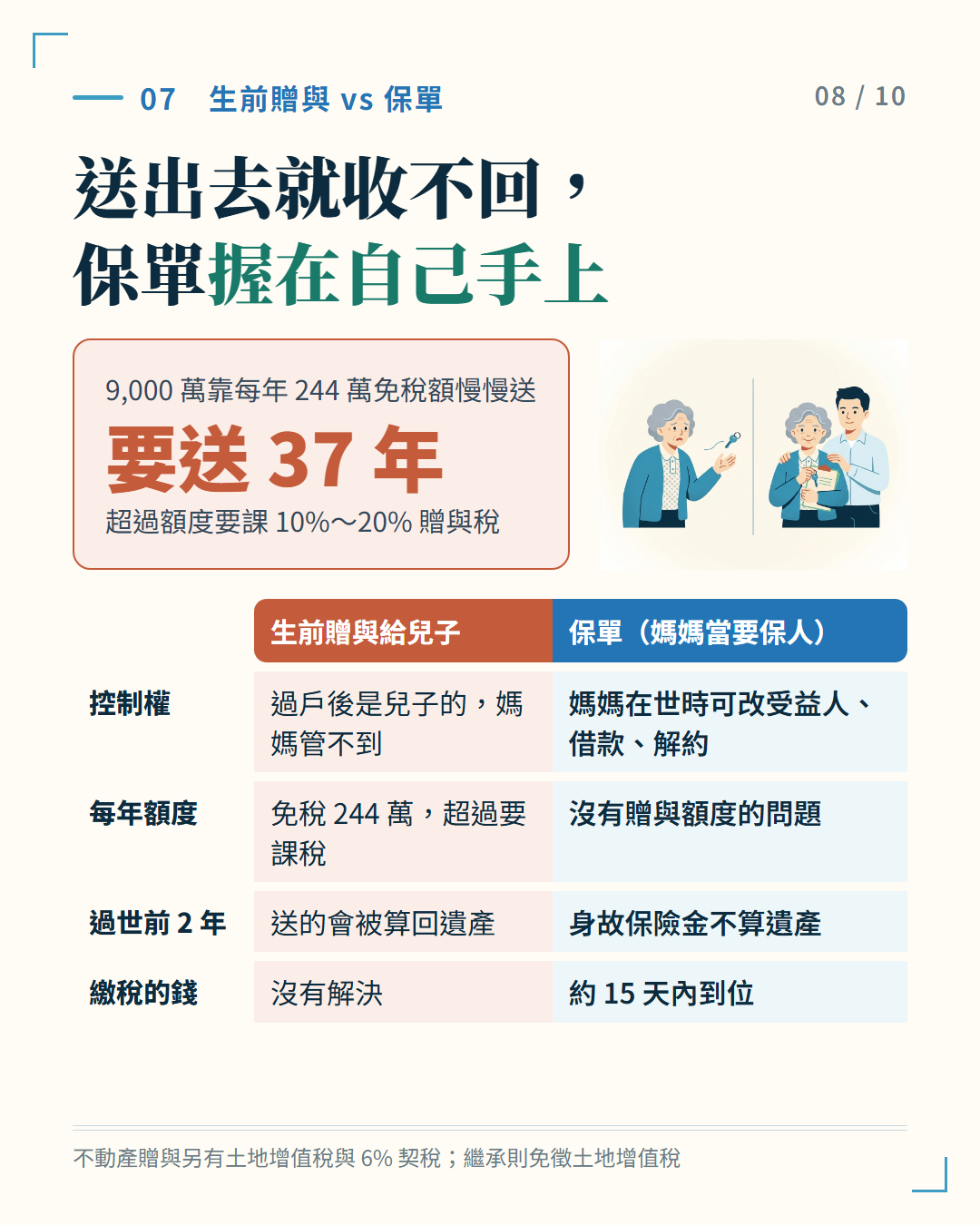
Gifting hands over control; insurance keeps control in your own hands
A policy is a tool, and setting it up wrong creates problems instead. Buying insurance should start with rational analysis anyway, and the same goes for estate tax:
The eight red flags aren’t a rule where hitting one means you’ll definitely be taxed. It’s an overall judgment, and the more you hit, the riskier it gets. The simplest way to avoid them: buy while healthy, pay in installments with your own money, size coverage to the tax, and don’t turn most of your assets into policies.
Two common mistakes to avoid: having three different people as policyholder, insured, and beneficiary (the payout is treated as a gift); and having the parent as policyholder with a child as the insured (when the parent dies, the policy value counts toward the parent’s estate).
One more small reminder: when the policyholder and beneficiary are different people, the death benefit the beneficiary receives counts toward the Alternative Minimum Tax (最低稅負制), but up to NT$37.4 million per household per year is excluded, which ordinary families rarely hit.
As for choosing the policy itself, the principles are the same as any insurance: first think through the “right, enough, good” principles.
Amendments to the Estate and Gift Tax Act passed their third reading on August 21, 2026, were promulgated on September 11, and took effect on September 13:
Installments and majority approval make paying smoother, but one thing hasn’t changed: you still need the money to pay the tax.
Also, if you hold US stocks, US estate tax runs on separate rules: non-US residents get an exemption of only US$60,000. The sub-brokerage vs. overseas broker post (in Chinese) compares them in detail.
This article is for educational purposes and isn’t personal tax, legal, or insurance advice. Tax calculations follow the Estate and Gift Tax Act and Ministry of Finance announcements for ROC year 115 (2026); the assets, premiums, and coverage in the example are assumptions and don’t represent any specific product. Whether the substance-over-form principle applies to a given case is decided by the National Taxation Bureau based on the actual facts, so check with an accountant, a land administration agent, or the tax bureau (toll-free 0800-000321) before planning.
Conflict of interest: I’m the CEO of Hippo Insurance (河馬保險) and work in the insurance industry. This article discusses insurance planning but doesn’t recommend any specific product; all information is for educational purposes only. If you’re an insurance agent and want to see how to start the estate tax conversation with clients, the Hippo blog has a complete story version written for agents (in Chinese).
Estate tax isn’t hard to calculate. The hard part is that nobody calculates it first. Calculate first, then decide whether to buy. That’s it.
🚀 已有 1,000+ 讀者加入理財成長之路
About Lazy Da I’m Mars, CEO of Hippo Insurance, with over 15 years in insurance and finance. I spent 8 years in insurance before moving into insurance software. Every week I use “Lazy to Be Rich” to break down money concepts, with the goal of helping beginners in Taiwan skip the detours. All data in this article comes from official sources, with the cutoff date noted.
📩 訂閱即送 · Lead Magnet
訂閱即送 「ETF 比較速查表」(VT/VOO/QQQ/0050 主流 ETF 五大面向比較)。每週一篇精選理財觀察 · 隨時退訂。