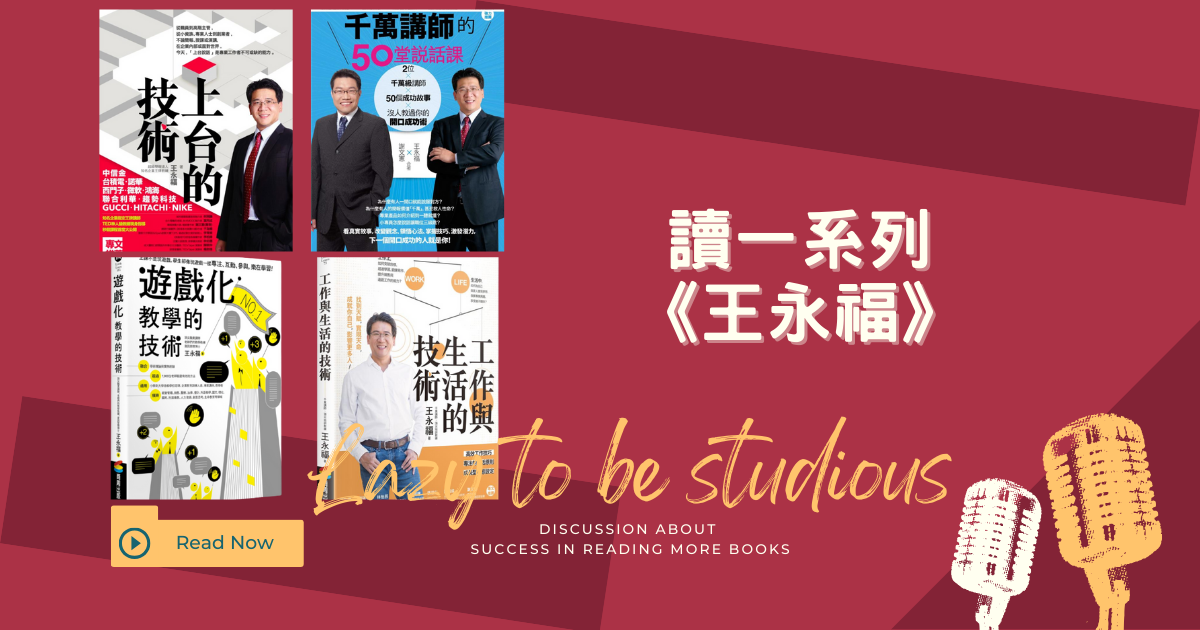
Who Is Wang Yong-Fu? 3 Classic Books by Presentation Master "A-Fu" to Master the Art and Courage of Public Speaking
In this article, you'll learn:
Why I Wanted to Read These Books
Wang Yong-Fu, also known as “A-Fu” (福哥). When I saw A-Fu’s background, I felt an instant connection—he had 8 years of experience in insurance, and I’ve been in the industry for 15 years so far. Aside from being a construction site supervisor (that’s not my area of expertise), A-Fu’s journey from insurance to computers, from sales to public speaking, is something I deeply relate to.
Over the past year, I’ve been giving talks at various insurance agency offices. Anyone who knows the drill understands: the eager sales agents just want to hear about pricing, the ones who were half-forced to attend are counting down to dismissal, and my presentations inevitably need to include some product explanations.
So I thought to myself—if I were Steve Jobs, how would I present a product in a way that touches people’s hearts? Are there any stories to tell? What are the key points? After reading the “Wang Yong-Fu” series, I came to deeply understand that “going on stage,” “daily life,” “work,” and “teaching” each require different skills to master.




What Are These Books About?
I previously mentioned in my review of 10x Efficient Business Book Reading that I started practicing thematic reading. A-Fu’s books are all skill-based instructional books, so I read them all at once. Here are the key takeaways I noted for each.
Every Presentation Should Focus on One Core Theme
When preparing a presentation, it’s crucial to identify a clear central idea. This approach helps the speaker stay focused, prevents topic fragmentation, and makes it easier for the audience to understand and remember the key points.
By focusing on a single core, the speaker can explore the topic in depth, provide more relevant details and examples, making the presentation richer and more persuasive. Additionally, it prevents the delivery from becoming too scattered, allowing the audience to better absorb and digest the content.
Each Core Theme Should Cover at Most Three Key Points
Distilling each core theme into three key points is an effective strategy. If someone asks you to remember one thing, that’s easy. But if a speaker can convey an entire presentation through just three key points, the audience is much more likely to remember them. At the end of the talk or course, you can also use these three key points for review and summary.
Put Yourself in the Audience’s Shoes—Think About What They Want to Hear
Everyone who attends a presentation or course has certain expectations. As a speaker or instructor, you should put yourself in each attendee’s shoes. Before the session, keep rehearsing what you want to say, and constantly ask yourself what each participant would want to hear.
For example, when I give morning talks at various insurance brokerage offices, what every agent most wants to know is probably “How to generate sales,” “Where are the clients,” “How to get clients to buy”—things like that. By connecting these different questions with the value and goals of your course, you can elevate the worth of every session and presentation.
Three Things to Understand Your Audience’s Needs
- What do they most want to know?
- What is their purpose for attending?
- What do they hope to take away when it’s over?
Ask Yourself: What Do I Want to Say?
How to Bridge What They Want to Hear and What You Should Say
The Inverted Pyramid Communication Style
- Lead with the conclusion
- Key takeaways summary
- Detailed explanation
Methods for Simplification
- Stories and memorable points
- Precise numbers
- Visual slides
Gamified Teaching
3 Key Elements
- Environment setup: Teams, rules, rewards
- Real-time feedback: Stimulation, response, motivation
- Course objectives: Establish goals, reinforce effectiveness
Define the Objective for Every Course or Presentation
- Knowledge-based objectives
- Skill-based objectives
- Attitude-based objectives
Three Psychological Needs That Create Intrinsic Motivation
- Hierarchy of Needs theory
- Two-Factor theory
- Achievement Motivation theory
Further Reading
Lazy Conclusion

🚀 已有 1,000+ 讀者加入理財成長之路