Why Does More Discipline Lead to More Anxiety? Reflections on "Make Time Your Friend": Understanding the Compound Interest Mindset for Investing
In this article, you'll learn:
Table of Contents
- Chapter 0: The Predicament — Problems, Panic, Solutions
- Chapter 1: Awakening — Who’s the Master, What Is the Mind, My Story
- Chapter 2: Reality — No Shortcuts, Exchange Is the Hard Truth, Perfection Never Exists, The Unknown Is Always There, You Can’t Escape the Present Right Away, Make Time Your Friend
- Chapter 3: Management — Estimating Time, Taking Action Now, Facing Difficulties, Focusing on Steps, Parallel and Sequential Tasks, Perceiving Time, Tracking Expenses, Setting Budgets, Planning Checklists, Process Rehearsals, Reviews
- Chapter 4: Learning — Efficiency, Essence, Basic Approaches, Key Methods, Limitations of Experience, Self-Learning Ability
- Chapter 5: Thinking — Think Diligently, Thinking Traps, Cause and Effect, Related Propositions, Case Limitations, Mix-Ups, Analyzing Insights, Overcoming Fear, Thinking Tools
- Chapter 6: Communication — Learn to Listen, What to Say and What Not to Say, Communication Principles, Accurate Paraphrasing, Reflect Often
- Chapter 7: Application — Interest, Methods, Pain, Comparison, Luck, Connections, Insecurity, Inspiration, Encouragement, Efficiency, Rhythm, Extremes, Self-Validation
- Chapter 8: Accumulation — Appendix
Why I Wanted to Read This Book
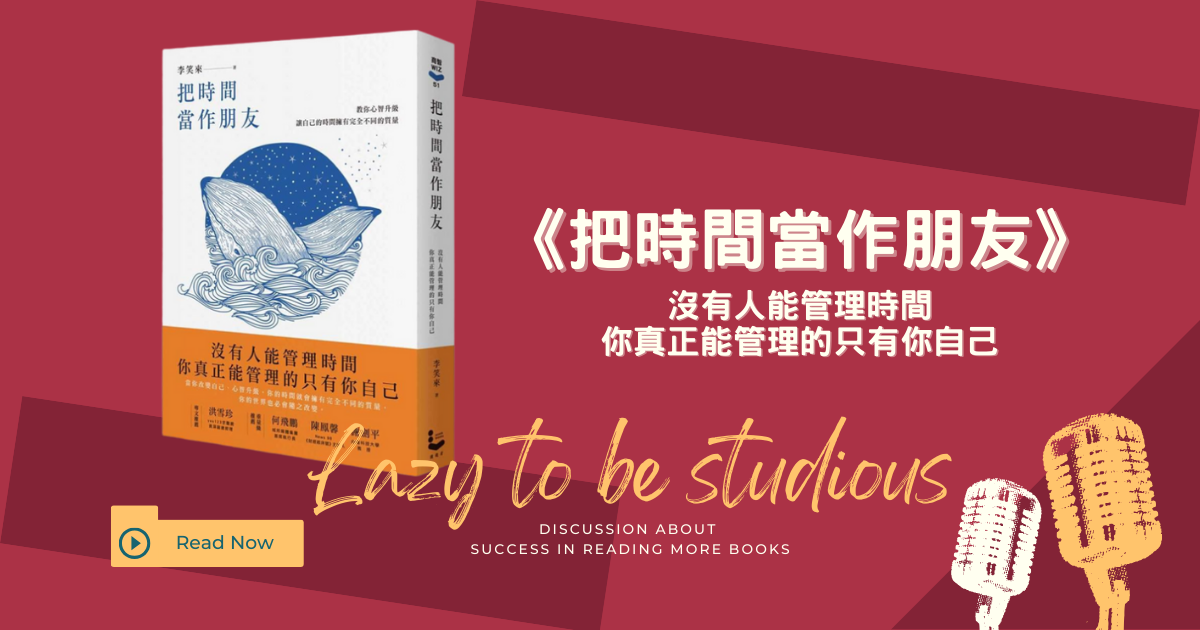
I first came across this book when I saw it mentioned in a reading review on “Green Horn’s Financial Notes” (綠角財經筆記, a well-known Taiwanese finance blog), so I added it to my reading list. The tagline on the cover grabbed me right away: “No one can manage time — the only thing you can truly manage is yourself.”
Beyond that, time is one of the most important variables in financial planning. Life, right? Who knows what your finances will look like in the future? Just live in the moment and enjoy, some might say. But if you approach enjoyment with a “better safe than sorry” mindset, wouldn’t that actually give you a more solid sense of peace?

What Is “Make Time Your Friend” About?
The author of “Make Time Your Friend” (把時間當做朋友) is Li Xiaolai (李笑來). He also wrote “The Road to Financial Freedom” (通往財富自由之路). If you read them together, they feel like a two-part series — and that’s actually how I read them, back to back.
No One Can Manage Time — You Can Only Manage Yourself
When I first saw this statement, I immediately understood what the author was getting at. Most people, when they talk about time management or time efficiency, forget to take a step back — we’re really just using units of time to manage ourselves. Time itself is just a constantly vanishing past; it’s merely a “concept.”
Even if you use something like TimeBoxing and call it “managing time,” I still wouldn’t call it that. Time, at the end of the day, is just a unit of measurement.

Make the 3+1 Learning Foundations Your Way to Level Up
The learning process consists of observation, experience, and trial-and-error. What can supplement these three is “reading.” Reading doesn’t just serve as a supplement — it can also be a form of preview. I also discussed this in EP28: This Week Really Had 2 Updates — Observation, Experience, Trial-and-Error, and Reading Are the 4 Underlying Logics of Learning, But They’re Not Easy to Apply to Personal Finance!.
Seeing/hearing it, doing it, learning it, and then forgetting it — that’s what I always say about the process of learning anything. Why does it end with “forgetting”? Not because you’ve literally forgotten, but because you’ve internalized it so deeply that it’s become second nature.
It’s just like learning a language — we never need to deliberately memorize common phrases because we use them every day. That’s why I believe the final stage of true learning is forgetting.
Personal Reflections and Thoughts
Reading through the entire book, I could really appreciate how the Chinese-language author writes with such clarity and accessibility. Compared to reading translated Western literature, it felt a lot more relatable (I’m actually starting to warm up to Simplified Chinese books).
Overall, the book feels more about mindset than techniques — the author spends more time on content that challenges you to rethink your own perspectives.

Why Is Independent Thinking So Hard?
“Thinking—or rather, independent thinking—is nothing more than this: when you hear a conclusion from someone else, you use your own brain to re-derive it, check whether the reasoning has any gaps or flaws, and evaluate whether the conclusion actually makes sense. This process isn’t that complicated, nor is it particularly mysterious. It’s simply what any normal, thinking person should do.” — Make Time Your Friend
My Take
The reason independent thinking is so difficult is that being independent means challenging everything around you — like being a duck among geese. The moment you challenge ideas or information that most of society accepts, you’re challenging the world. It doesn’t mean independent thinking has to be rebellious, but many people fear that being different from others is equivalent to being judged. Not thinking at all saves you the trouble. And blindly trusting authority? That’s a trap in itself.
Further Reading
Lazy Da’s Takeaway

Indeed, your greatest asset and your greatest cost is time — whether in personal finance, work, or life. You’ll find that if you constantly ask yourself “how much time does this cost?” then maybe life will become a little more intentional.
Reading books from mainland China, you’ll encounter some lofty, abstract theories — that’s partly what I’ve come to expect from Chinese authors. I haven’t read many mainland Chinese books yet, but these two confirmed my impression. The reasoning all tracks, and it genuinely makes you think from new angles.
For any source of information, as long as it helps you think more independently, I believe it’s worth exploring.
🚀 已有 1,000+ 讀者加入理財成長之路

Buy the Book