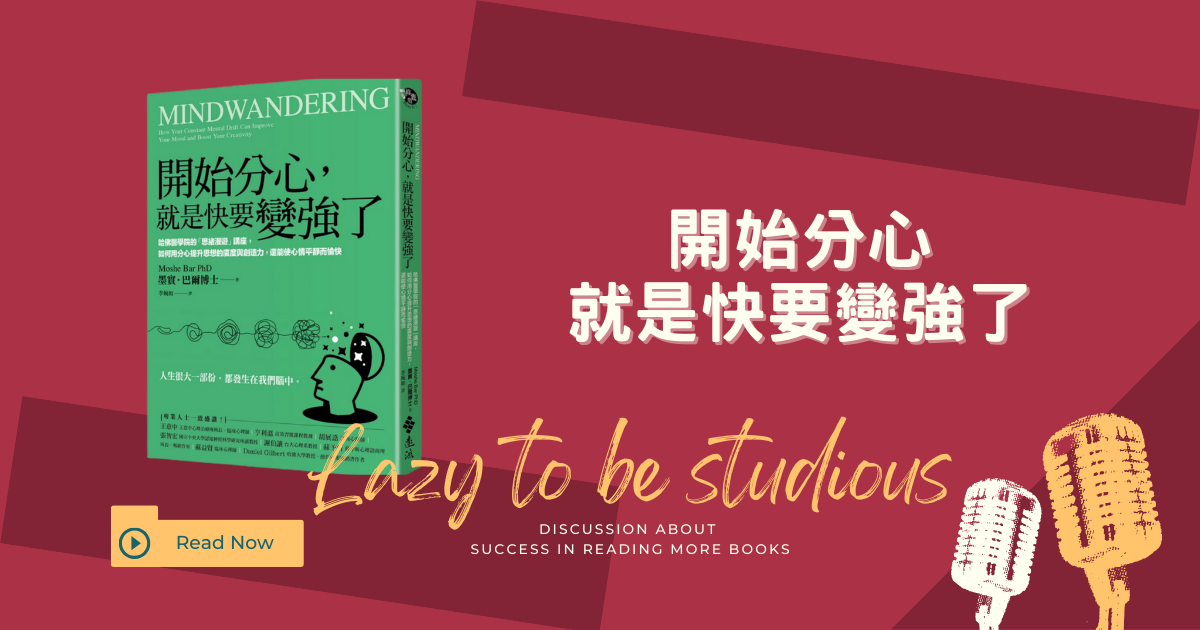
Distracted = Inefficient? Research Reveals 47% of Mind-Wandering Time Is a Superpower! Review of "Mindwandering"
In this article, you'll learn:
Table of Contents for “Mindwandering”
- Chapter 1: Always in “On” Mode
- Chapter 2: Understanding Our “Thoughts”
- Chapter 3: The Journey Away from the “Present”
- Chapter 4: What Do We Think About During “Mind-Wandering”? First, the “Self”
- Chapter 5: Inferences About “Others”: Things Could Go Wrong
- Chapter 6: Future Memories: Learning from Imagined Experiences
- Chapter 7: Losing the Sense of Novelty
- Chapter 8: Mental Templates and Boundary Constraints
- Chapter 9: Breadth of Thinking, Creativity, and Mood
- Chapter 10: Meditation, the Default Brain, and the Quality of Experience
- Chapter 11: An Immersive Life
- Chapter 12: The Best Mental State for the Occasion
- Appendix: From the Lab to Everyday Life
What Is “Mindwandering” About?
The author of “Mindwandering” is Dr. Moshe Bar (Moshe Bar). Here are the key takeaways I got from reading the entire book:
- Mind-wandering
- Exploratory states
- Exploitative states
- Mindfulness (being present)
- Meditation
This book was written by a neuroscience PhD. It’s packed with specialized terminology, and if you read the Chinese translation too intensely, it can feel especially hard to grasp.
A lot of the time, we’re actually in a distracted state. According to the data in the book, a whopping 47% of our time is spent distracted — maybe thinking about what just happened, or what’s coming next, but rarely in the “present moment.” Yet many of our most meaningful “experiences” can only be fully received by “living in the now.”
After reading the whole book, you’ll understand the author’s explanations of “why we get distracted,” “how distraction affects us,” and “how to distinguish and leverage different states of distraction.”
Why I Wanted to Read This Book
I’m someone who gets distracted very easily, and I felt a strong resonance with the book’s claim that “people who frequently get distracted tend to be more creative.” I discovered this book while browsing the psychology section at the library — the title caught my eye. As I flipped through the pages, I found a passage very similar to something from Atomic Habits:
“Beliefs” can change our reactions to events, even unconsciously altering our pathology, psychology, and physiology.
I remember the author of Atomic Habits had his own powerful story of transforming pain into success. And this book happens to touch on similar ideas.
I also started exploring Mindfulness in 2024, and this book covers a lot of scientific reasoning related to Mindfulness and meditation. So I wanted to dig deeper into the topic.

Becoming Aware of Your Distraction and Using It Wisely
The key concept you need to understand in this book is “mind-wandering.” The way I see it, in plain language, it’s basically productive distraction — a scientific or psychological term for a certain kind of distraction. That doesn’t mean mind-wandering is wrong — to enter a state of mind-wandering, you actually need the right combination of experience and knowledge.
“Mind-wandering” is a broadly defined term. It’s generally believed that when our minds wander, we mainly think about ourselves and others, and we predict, plan, and simulate how to handle future events.
Mind-Wandering Usually Starts with Self-Awareness
Whether it’s “I” in English or “我” (wǒ) in Chinese, it sounds like the most ordinary word. But have you ever thought about it: when you praise yourself or scold yourself, is the “I” still the same “me”?
From my reading of this book, I can notice which version of “me” I’m in — the “subject-I” or the “object-I.” For example, when I notice that I’ve gotten distracted, that’s the object-I talking to the subject-I. The book describes a scenario where you’re watching a movie and suddenly zone out (for me, I usually fall asleep), then snap back. You’ve probably experienced it too — coming back to yourself and asking: “Where did I just go?” That’s essentially the “subject-I” having a conversation with the “object-I.”
Mind-Wandering Also Involves Perceiving Others
“Mind-wandering” is a combined product of experience and knowledge. We use memory to connect experience and knowledge, and then enter a state of “predicting others.”
My plain-language interpretation: it’s “jumping to conclusions” or “liking to interrupt.” Those sound pretty negative, right? Yes, they lean negative — maybe someone says “Oh, really?” but it sounds to you like “So what?” That’s a kind of “pre-judgment.”
The book explains that this “pre-judgment” is an active “early warning system” in the brain. It’s not about whether this system is good or bad — it’s simply describing the phenomenon.
Why We Always Love New Things
You’ll notice people tend to prefer novelty over familiarity, and most people are like this. But in this book, this tendency is portrayed as the source of human progress. Have you noticed that we’re more easily stimulated by new things or objects, precisely because they exceed our “memory and knowledge” and fall outside our “range of predictions”? And we deeply enjoy the process of creating those predictions.
Rather than saying the brain is figuring out “what is this?” when encountering something new, a better explanation is actually “what does this resemble?” — because we use “memory and knowledge” to form “associations” with new things.
Say you see a triangle you’ve never seen before: when you’re hungry, you might say it looks like a sandwich; when your car breaks down, you might say it looks like a warning sign. Try spending an afternoon lying in the shade at a park, staring at the clouds and thinking. You’ll find you never ask “what is that?” but rather “what does that look like?” Rationally, it’s just a cloud, but your brain can’t help taking you somewhere new.

Mindfulness: Being Present
Immersive Experience Requires Focus
The book devotes considerable space to Mindfulness and meditation. Mindfulness has been promoted in Taiwan for some time now. I was introduced to seated meditation back in elementary school (calling it a “technique” is fair — after all, it’s not easy for the average person to sit still without moving).
In recent years, we often hear about “immersive experiences” and “experience value.” Whether an activity produces a good or bad experience, it usually requires “immersion,” and the most important part of immersion is letting your body feel things naturally — not forcing it. It’s like the old saying: “Don’t think about an elephant” — and an elephant immediately pops into your mind.
Personally, I think a movie theater is an excellent place to practice awareness. As long as you don’t fall asleep, staying conscious that you’re watching a movie — not drifting off to the plot of the previous film (like in interconnected series such as the Marvel Universe) — that’s practicing immersion.
Seated Meditation Helps You Practice Awareness
Talking about meditation usually sounds like it’s heading into philosophy, mysticism, or religion. But scientific meditation has absolutely nothing to do with those. Through scientific meditation, you can sharpen your awareness, and through the emptiness of meditation, you allow your natural self to have a conversation with your natural self — that’s what practicing awareness is.
Why seated meditation? I simply think it’s because if you walked around talking to yourself in broad daylight, people would think you’re crazy. But what you might not realize is that you’re constantly having self-dialogue — whether you’re giving yourself a pep talk after your boss just lectured you, or silently cursing a coworker who spilled your drink. These are all forms of self-dialogue.

Recognizing the Power of Awareness
Once I can consciously notice my own states, I can more discerningly engage in every activity.
Take my conversations with my kids, for example. Here are some phrase substitutions I often use:
| Instinctive Phrasing | Awareness-Based Phrasing |
|---|---|
| “Did you forget?” | “Do you remember?” |
| “This side or that side” | “Left or right? Top or bottom?” |
| “Stop throwing toys all over the floor” | “If you tidy up your toys, it’ll be neat” |
| “Don’t play around when you get home” | “Take a bath first when you get home” |
It’s not that these substitute phrases work 100% of the time or magically make kids obedient. The point is that compared to instinctively scolding children, consciously guiding them with positive language creates more harmony over the long term.
Walter Pater said: Our failure is in forming “habits.” No two moments in life are alike, no two people are similar, no two flowers look the same, and every sunset is different.
Our brains and thoughts help us process information by quickly finding analogies for “what something resembles,” but this same “habit mechanism” also leads us to treat individual things as “categories,” preventing us from savoring the rich layers of a French pastry éclair every single time we enjoy one.
Clear Your Mind to Make Room for New Ideas
I get distracted a lot, and I’m consciously aware of it. That’s why I’ve set up a dedicated “quick inspiration notes” section in my note-taking system — so I can rapidly capture those fleeting thoughts before they vanish from my mind. Through self-awareness, I deeply understand the irreversibility of time, so I often remind myself to cherish every minute and make the most of each moment doing meaningful things.
I believe every spark of inspiration has its value — it might even become the foundation for an important future decision — which is why this kind of recording is so important to me.
Further Reading
Lazy Da’s Conclusion

“Mindwandering,” written by neuroscientist Dr. Moshe Bar, explores topics such as mind-wandering, exploratory states, Mindfulness, and meditation.
The book points out that our brains are frequently in a distracted state — and this distraction can actually foster creativity. The author explains why we get distracted, its effects, and offers advice on how to make the most of it.
The book also emphasizes the importance of being present (Mindfulness) and meditation, which can enhance our awareness and overall quality of life.
In summary, this book provides scientific insights on distraction and focus, along with practical tips for improving your abilities. If you find the psychology jargon difficult, there’s no need to read too deeply — just understanding the principles is enough.
🚀 已有 1,000+ 讀者加入理財成長之路

Buy the Book