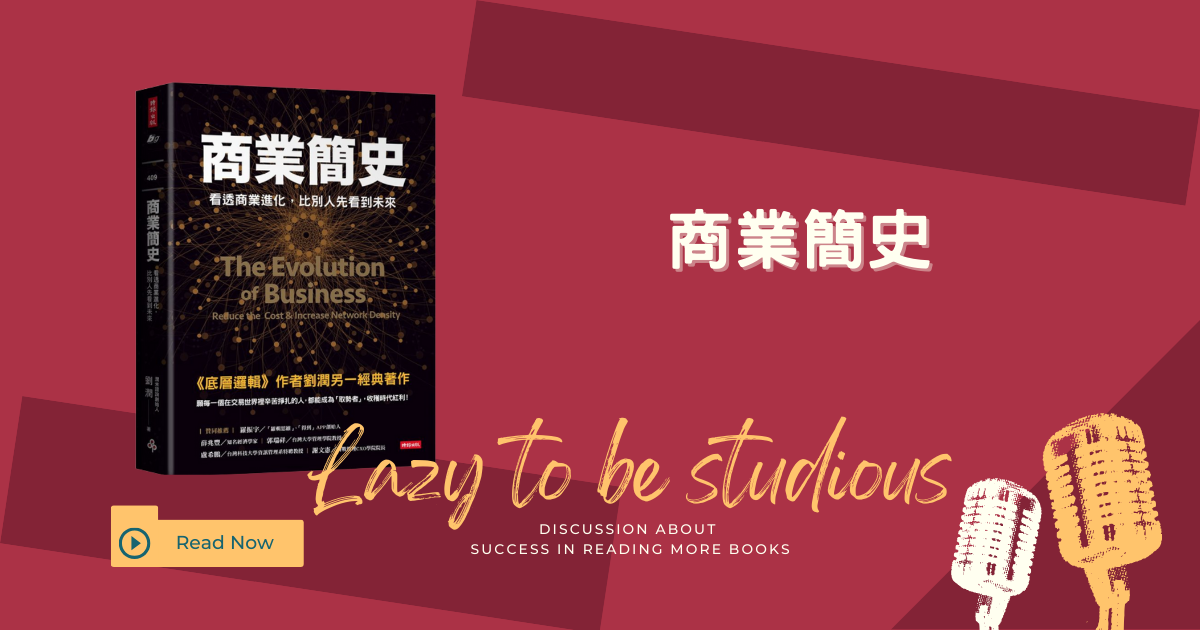
Why Do Most Startups Fail? "A Brief History of Business" Reveals the Cruel Truths of Commerce You Never Knew
In this article, you'll learn:
Table of Contents for “A Brief History of Business”
- PART1
- What is business, really?
- 1 The essence of business is transactions
- 2 The great divide in transactions: information asymmetry and non-transferable trust
- 3 Business evolution: bridging the divide and reducing transaction costs
- 4 All great opportunities stem from massive structural changes
- PART2
- Connectivity is the driving force behind structural change
- 1 Railways: Sears and its mail-order catalogs
- 2 Highways: Walmart in small towns
- 3 Shipping: How containers changed the world
- 4 Telegraphs: The first information superhighway
- 5 The Internet: An explosion of great opportunities
- 6 The Internet of Things: The next direction of the current
- PART3
- Linear commerce: The sub-evolution of the business world
- 1 Network density and business evolution
- 2 Linear commerce: Connecting across greater distances
- 3 How does linear commerce reduce transaction costs?
- PART4
- Centralized commerce: The Jurassic era of the business world
- 1 What is centralized commerce?
- 2 How centralized commerce solves information asymmetry
- 3 How centralized commerce solves the non-transferable trust problem
- PART5
- Decentralized commerce: The inevitable trend of “divide after unity”
- 1 What is decentralized commerce?
- 2 How decentralized commerce solves information asymmetry
- 3 How decentralized commerce solves the non-transferable trust problem
- PART6
- Fully connected commerce: The utopia of the business world
- 1 Fully connected commerce: Network density = 100%, transaction cost = 0
- 2 The path forward: Left foot, right foot, then left foot again
- PART7
- How do we ride the wave?
- 1 What is true “profit”?
- 2 How to “turn right” and earn profit?
- 3 Write your own business history of the future
Why I Wanted to Read This Book
The reason I picked up this book was mainly because I’ve been practicing thematic reading. A while back, I was thinking about whether there were any business-related books I could start sharing with my son from a young age. That’s how I found Business Enlightenment for Children.
📚 Recommended Reading: Book Review: “Business Enlightenment for Children”
Digging deeper, I discovered that Liu Run is also the author of The Underlying Logic. So I decided to read all of Liu Run’s books, and this one—A Brief History of Business—was one of them.

What Is This Book About?
“The essence of business is transactions.” The author traces commercial activity from agricultural societies all the way to the modern era, allowing you to understand “business behavior” in the simplest way possible. As time progressed, from the earliest “spatial arbitrage transactions” to “information gap transactions” to today’s “decentralized transactions”—each stage is illustrated with stories you’re already familiar with.
Highways, railways, aviation, shipping—the folding of space made it possible for American products to be used in Taiwan.
Wired telecommunications, undersea cable networks, wireless communications—the folding of time allows you to tap your phone and instantly reach someone on the other side of the world.
Through the book’s layered narrative, you can quickly grasp the evolution of commerce as if you were reading history stories. Beyond transactions, the essence of business also involves a hidden factor: “trust.” You might think banks exist for interest rates, right? Not exactly—banks exist as intermediary transaction points to resolve the distrust that may exist between people. Without the spread of transportation and the internet, it would be very hard for us to find small-farm products on our own. We usually go through trusted middlemen. It’s just like how most convenience stores stock foods and goods that can be trusted.
There’s a passage in the book about “dividends,” “profits,” and “wages.” In the world of business, price wars are about grabbing dividends. As more and more players enter the price war, all that remains in the end are wages. You must build business protection while the dividends still exist—that’s what real “profit” is.
Note
Dividends: A temporary supply-demand imbalance
Wages: You think you’re running a business, but you’re actually working for society
Profit: Comes from the absence of competition

Personal Reflections and Thoughts
How It Felt Reading This Book
The entire book can be summed up in one word: “smooth.” From ancient agricultural barter to modern online shopping, you can follow the narrative thread to understand what A Brief History of Business intends to convey—finding traceable business profits. I think if you’re planning to start a business or have already done so, this book is worth a read. Of course, if you’re a salaried employee, it’s also valuable. Just treat the “center point” in the book as yourself—you should also understand how to manage your own personal brand.
The 3 Quotes from This Book That Struck Me the Most
💡 In that destined brilliant future—am I included?
This line comes from the author’s preface. When everyone keeps asking, “Is it okay for me to do this?”, a different way of thinking would be: “Maybe that thing was never not okay”—I’m referring to business activities, not criminal behavior.
The author says in the preface: Business doesn’t care about your direction, but you must care about the direction of business. It’s like saying things have never been easy, but the key is always whether you’ve done the work well!
💡 All great opportunities stem from massive structural changes
Think of this as Elon Musk developing reusable rockets, and you’ll understand what it means for great opportunities to come from massive structural changes. This is transportation’s version of folding space.
Every “transaction” involves information asymmetry and non-transferable trust. The reason this quote resonated so strongly is that the financial industry I work in is quietly undergoing massive change due to fintech. You no longer need a bank to store money (it’s not called “deposits” anymore but “stored value”). There will be even more disruptions in the future.
💡 The greatest cost of business: information asymmetry and non-transferable trust
Precisely because of the second quote, the third one made me feel that as information becomes more symmetrical and trust becomes more transferable, truly zero-cost transactions might actually emerge someday. And that’s when we need to ask ourselves: what is the value of the “people” standing in the middle?
Note: The financial industry is the quintessential example of information asymmetry and difficulty in trust transfer.
Further Reading
Lazy Conclusion

This book was originally just something I stumbled upon through thematic reading. I never expected that behind such a short, unassuming title, the content would be so rich and substantial. Although I haven’t yet read The Underlying Logic or other books by Liu Run, my previous experience reading Business Enlightenment for Children combined with this A Brief History of Business has already made me look forward to the author’s other works.
Every book, whether due to publishing requirements or binding constraints, has a certain word count. So sometimes a thick book doesn’t mean every page is a highlight. As long as you find one sentence in the book that’s powerful enough to change your behavior or thinking, I believe it’s absolutely worth it.
🚀 已有 1,000+ 讀者加入理財成長之路
Purchase Links