"Just Keep Buying" Review: Data Proves the Key to Wealth Isn''t "When to Buy" but "Keep Buying"
In this article, you'll learn:
Table of Contents
- Where Should You Start?
- Assess your current financial situation
- How Much Should You Save?
- The problem with most savings advice
- Determine how much you can save
- Why you need to save less than you think
- How to Save More Money
- The biggest lie in personal finance
- How to increase your income
- Sell your time/expertise
- Sell a skill/service
- Teach
- Sell a product
- Climb the corporate ladder
- To save more, think like a business owner
- How to Spend Money Without Guilt
- The 2x Rule
- Focus on maximizing fulfillment
- The only right way to spend money
- How Much Lifestyle Inflation Is Acceptable
- Why high savers need to save more of their raises
- How much of your raise should you save?
- Why you should save 50% of your raise
- Should You Take on Debt?
- Why debt isn’t necessarily bad
- When you should consider borrowing
- Why getting a college degree is usually worth it
- The non-financial costs of debt
- Debt as an option
- Should You Rent or Buy?
- The cost of buying
- The cost of renting
- Buying a home as an investment
- It’s not about whether to buy, but when to buy
- The right time to buy a home
- How to Save for a Down Payment
- Is saving in bonds better than cash?
- What if you need to save for more than 2 years?
- Is saving in stocks better than bonds?
- Why time is the most important factor
- When Can You Retire?
- The 4% Rule
- Why spending decreases after retirement
- The Crossover Point Rule
- The bigger concerns after retirement
- Why You Should Invest
- Save for your future self
- Fight inflation to preserve your wealth and purchasing power
- Replace your human capital with financial capital
- What Should You Invest In?
- Stocks
- Bonds
- Investment real estate
- REITs
- Farmland
- Small businesses/franchises/angel investing
- Royalties
- Your own products
- Gold, cryptocurrency, art
- Summary
- Why You Shouldn’t Buy Individual Stocks
- The financial argument against stock picking
- The existential argument against stock picking
- Track your stock-picking performance
- How Early Should You Start Investing?
- Most markets go up most of the time
- Why better prices may come in the future
- Invest now or dollar-cost average?
- What about non-stock asset classes?
- What about risk?
- Does investing uninvested cash in Treasury bills matter?
- Should you care about valuations?
- Summary
- Why You Shouldn’t Wait to Buy the Dip
- Understanding how buying the dip works
- Summary
- Only God wins
- Why Investing Depends on Luck
- How your birth year affects your investment returns
- Why the sequence of returns matters
- The ending matters most
- How to mitigate bad luck as an investor
- Why You Shouldn’t Fear Market Volatility
- The price of admission
- There is no magic genie
- How to Buy During a Crisis
- Why market crashes are buying opportunities
- Change how you think about rallies
- What about markets that don’t recover quickly?
- When Should You Sell?
- Sell all at once or gradually?
- What are the benefits of rebalancing?
- How often should you rebalance?
- Getting rid of a concentrated (or consistently losing) position
- The purpose of investing
- Where Should You Keep Your Investment Assets?
- The ever-changing nature of taxes
- Roth 401(k) or Traditional 401(k)?
- Simplifying the choice between Traditional and Roth 401(k)
- Thinking about future tax rates
- When is a Traditional 401(k) the better choice?
- When is a Roth 401(k) the better choice?
- Why not use both?
- Quantifying the tax benefits of investing through retirement accounts
- Why you might not want to max out your 401(k)
- The optimal arrangement for investment account placement
- Why You’ll Never Feel Rich
- I’m not rich—they are
- Why even billionaires don’t feel rich
- The Most Important Asset
- The old man who moved mountains
- We start life as growth stocks and end as value stocks
Why I Wanted to Read This Book
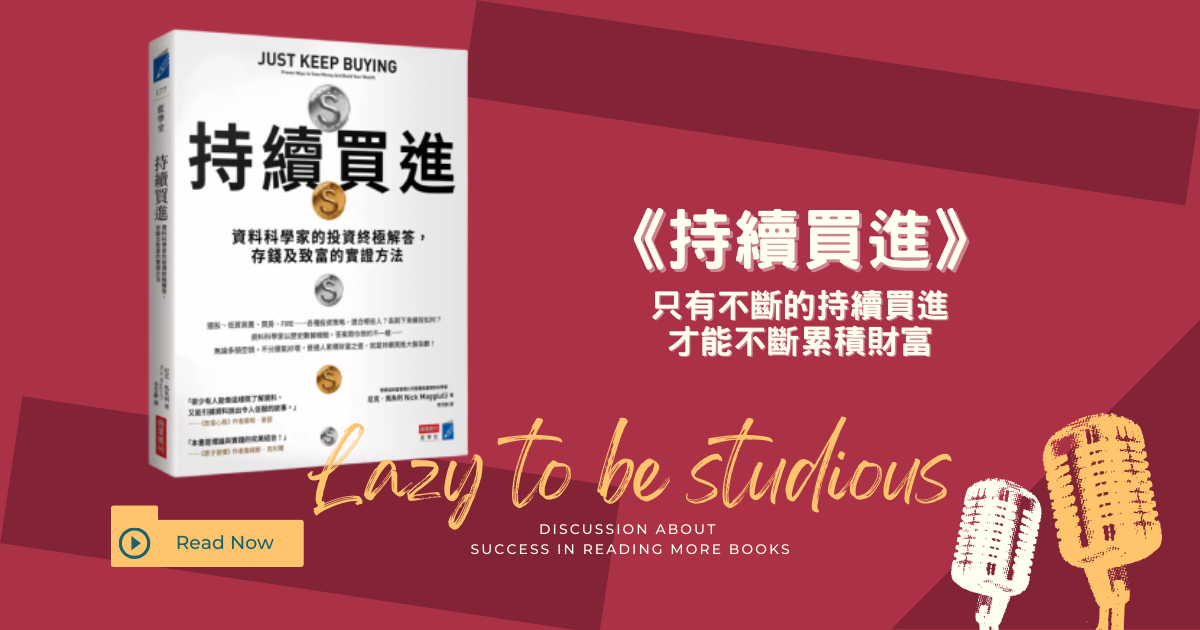
Just Keep Buying—this concept was actually something I kept repeating when I started working as a financial advisor seven years ago. The wealth in the stock market is just sitting there, waiting for us to claim it. Do you need to buy and sell, buy low and sell high? Of course—but the frequency of buying comes from “consistency,” and the frequency of selling comes from “need.” If I already understand the concept, do I still need to read books like this? Don’t forget—the purpose of reading is to enrich yourself. As long as even one sentence in a book can level you up, any type of book is absolutely worth reading.
What Is Just Keep Buying About?
The author of this book is Nick Maggiulli, a data scientist and investment expert. In the book, he describes watching his grandfather gamble away his retirement money on horse racing, leading to a miserable old age. Growing up, Nick used his strengths in data analysis and investment expertise to debunk common investment myths. Backed by data, he proposes the simplest yet most effective investment mindset: “Just Keep Buying.” The book’s core message encourages readers to start investing as early as possible and develop the habit of investing consistently, regardless of market direction—Just Keep Buying. The author believes that time is an investor’s most important asset, because time can’t be bought with money, and everyone’s time is limited. So rather than spending time trying to predict market timing, it’s better to seize the time and enter the market early, letting compound interest grow your assets over time.
The Book Presents 3 Arguments for Why You Should “Just Keep Buying”
- Dollar-cost averaging beats buying the dip: Based on historical data analysis, the author found that long-term regular investing typically outperforms the buy-the-dip approach. No one can accurately predict market bottoms, and waiting for the perfect moment actually means missing out on market gains.
- Investing in broad-market ETFs beats picking individual stocks: The author argues that investors should choose market-cap-weighted ETFs rather than individual stocks. Individual stocks carry higher risk, require more research time, and most actively managed fund managers underperform the market anyway.
- Focus on your career and increase your income: The author advises investors to focus on boosting their primary income, as this is the most stable and reliable way to increase investment capital. The book also emphasizes the importance of saving, encouraging readers to build good savings habits so they have more money to invest. Just Keep Buying offers an investment approach that’s perfect for people who want to start investing but don’t know where to begin. The investment philosophy is simply “Increase your income, just keep buying”—focus on your career and keep investing, and you can build wealth.
Should the Poor Focus on Saving While the Rich Invest Aggressively?
Defining “Poor” and “Rich”
First, we need to clarify: how do we define “poor” and “rich”? By income, assets, or some other measure? Different definitions may lead to different investment strategy recommendations. Personally, I suggest using the most straightforward definition.
Warning
An annual income over NT$1 million is a basic dividing line.
For someone earning NT$30K, NT$40K, NT$50K, or NT$80K per month, investing 30% of their salary with an assumed 8% return—what would the returns look like after 5, 10, 15, and 20 years? How big is the difference? Here’s a comparison table:
| Monthly Income | Monthly Investment | Return After 5 Years | Return After 10 Years | Return After 15 Years | Return After 20 Years |
|---|---|---|---|---|---|
| NT$30K | NT$9,000 | NT$125,145 | NT$558,616 | NT$1,426,062 | NT$2,975,729 |
| NT$40K | NT$12,000 | NT$166,860 | NT$744,821 | NT$1,901,416 | NT$3,967,639 |
| NT$50K | NT$15,000 | NT$208,575 | NT$931,026 | NT$2,376,770 | NT$4,959,549 |
| NT$80K | NT$24,000 | NT$333,720 | NT$1,489,642 | NT$3,802,832 | NT$7,935,278 |
Note
Investing 30% monthly, the net return difference after 10 years can be up to 3x. This doesn’t even account for lifestyle inflation as income grows. If someone earning NT$80K lives on a NT$30K budget, the gap would be even larger.
The point of this table isn’t to emphasize the rich-poor divide, but to show that when our salary is lower, we should actively invest in ourselves to increase our income. For example, someone earning NT$30K could save up NT$100K, take courses at a tech training institute (like Taiwan’s Institute for Information Industry), transition into software engineering, and significantly boost their earning potential.

The Relationship Between “Saving” and “Investing”
“Saving” is the first step in building wealth—without savings, there’s no capital to invest. The book mentions the concept of “paying yourself first,” which encourages people to set aside a portion of their income first as investment capital upon receiving their paycheck. This is what I always call “Earn > Save > Spend.” Once you’ve saved 3 to 6 months of emergency funds, you should start actively investing through dollar-cost averaging, consistently putting money into the market.
Info
“Investing” is the way to grow your capital. By investing in stocks, bonds, funds, and other instruments, you can earn higher returns than bank deposits, fight inflation, and if the market exceeds expectations, you may reach your financial goals even faster.
“Time” Is More Important Than “Money”
The book repeatedly emphasizes the importance of “time,” because time can’t be bought with money, and everyone’s time is limited.
For young people, especially during the period of fastest income growth (ages 25–35), you should focus on improving your skills and increasing your income, because this is the most efficient way to build wealth.
Whether “poor” or “rich,” everyone should seize the time and start investing early so that through the power of compound interest, wealth can grow steadily.
Info
Further Reading:
[Book Review] Make Time Your Friend Reading Notes
Further Listening: EP29: Financial Freedom Is a Mindset, Financial Planning Is a Skill—Learn “Metacognition” to Upgrade Your Brain!
The Importance of “Money”
- Invest in yourself to improve your quality, and increase the quantity of your money.
- The accumulation of money influences compound interest outcomes.
- Blindly chasing returns may overexpose your money to risk.
The Importance of “Time”
- Time is a key factor affecting investment returns.
- The compound effect of time can grow wealth steadily.
- The value of time can’t be measured in money—once it’s gone, it’s gone forever.

No Matter Who You Are, Start Investing Early
Regardless of your income level, once you’ve saved 3–6 months of emergency funds, you should Just Keep Buying. Only through Just Keep Buying can you harness the power of compound interest over time and grow your wealth steadily.
Further Reading
Lazy Da’s Conclusion

The core philosophy of “Just Keep Buying”
Invest early: Due to the compound effect of time, the earlier you start investing, the faster your wealth grows.
Invest regularly: Through dollar-cost averaging, you can spread investment risk and build a disciplined investing habit.
Invest for the long term: Investing is a long-term process—don’t let short-term market fluctuations affect your decisions.
🚀 已有 1,000+ 讀者加入理財成長之路
Buy the Book