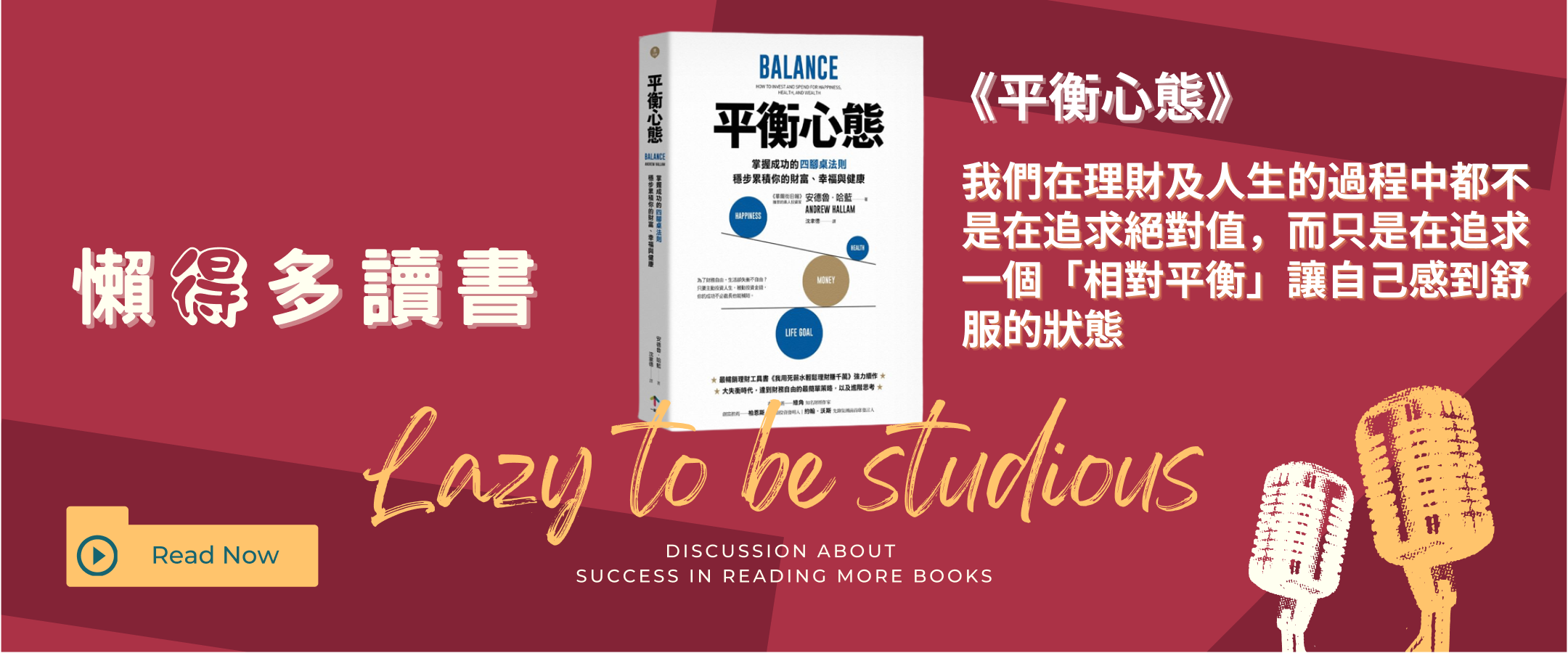
Book Review — "The Balance": Cracking the Dilemma of Wealth and Life with a Practical Guide to 4 Key Pillars
In this article, you'll learn:
How to Have Your Cake and Eat It Too
A while back, I posted something on Facebook about “talking nonsense” (a self-deprecating humor style common in Taiwan), and to my surprise I got to use the idea right away in this article. We often face choices, and my usual follow-up line is: “Once you choose, you take responsibility.” Nobody wants to make a wrong decision, and at the moment of decision, every choice seems like the right one. “Having your cake and eating it too” is usually an either/or question — but today, you can have both the fish and the bear’s paw (a Chinese idiom for wanting it all). All you have to do is imagine it in your head, and you’ve got it!
Sounds like nonsense, right?
This is actually my interpretation of a line from the book The Balance.
💡 Things often seem absolute, but there is always a relative side.
In our journey through personal finance and life, we’re always searching for “relative balance” — meaning there’s no “absolute value.” Many people ask whether something is “good or bad,” “right or wrong,” only to realize later that there’s really no right or wrong — everything is just a matter of which side of the scale tips a little more.
A Successful Life Has Four Elements
- Having enough money
- Maintaining solid relationships
- Staying in optimal physical and mental health
- Living with purpose
These four elements greet you right from the first page, and they’re essentially what we discuss in financial planning when setting life goals. Some people want a car, a house, kids, a spouse, and all sorts of things they want or need — but it always comes back to money. Beyond money, you also need “relationships,” “health,” and “purpose.” These are all ingredients for happiness.
Having Enough Money
When it comes to money, everyone thinks about having “more,” but nobody discusses “enough” — and that’s where greed comes in. Nobody wants to have “less,” but nobody discusses what “lacking” really means — so there’s nothing to say. Having enough money is the balance that lets you feel satisfied. “You don’t need money to be happy” — that’s a lie. If you can’t even afford to live, where does happiness come from? (Don’t be fooled by those unrealistic TV dramas.)
Recommended reading: Having Money Doesn’t Guarantee Happiness, But Not Having Money Usually Means Unhappiness
The Balanced Choice
If your current annual income is NT$600,000, your job doesn’t require overtime, and all your living needs are met — would you switch to a job paying NT$800,000 a year but with zero personal time? I’m not deliberately avoiding asking about a NT$6,000,000 salary — it’s just that jumping from a NT$600,000 skill set to a NT$6,000,000 position is hard to imagine. Maybe it’s possible, but it’s not the norm. So when we discuss balance, we don’t talk about extreme exceptions.
Investment Choices
The book mentions some investment approaches, and the line that hit me hardest was:
The best investment is to buy stocks and then forget you own them.
This isn’t just empty talk. You’ve probably seen news stories about someone’s parents buying a certain stock decades ago, and by now it’s multiplied many times over. Isn’t that the best proof that the above statement is true?
Balance Is a State of Getting By Without Going Without
If you’ve been following my articles for a while, you’ll notice that the financial management I discuss is almost always about mindset. Because only when your mindset truly changes will your financial management truly align with your financial plan. Many people think that when money isn’t enough, just earning more will solve the problem. But the reality is, more money can’t fix a poverty mindset. The “poverty mindset” I’m referring to here isn’t about actually feeling sad about life — it’s precisely because you don’t feel truly distressed that it becomes a real poverty mindset.
Further Reading
The Lazy Conclusion

🚀 已有 1,000+ 讀者加入理財成長之路
Purchase Links