財務工具與金融商品
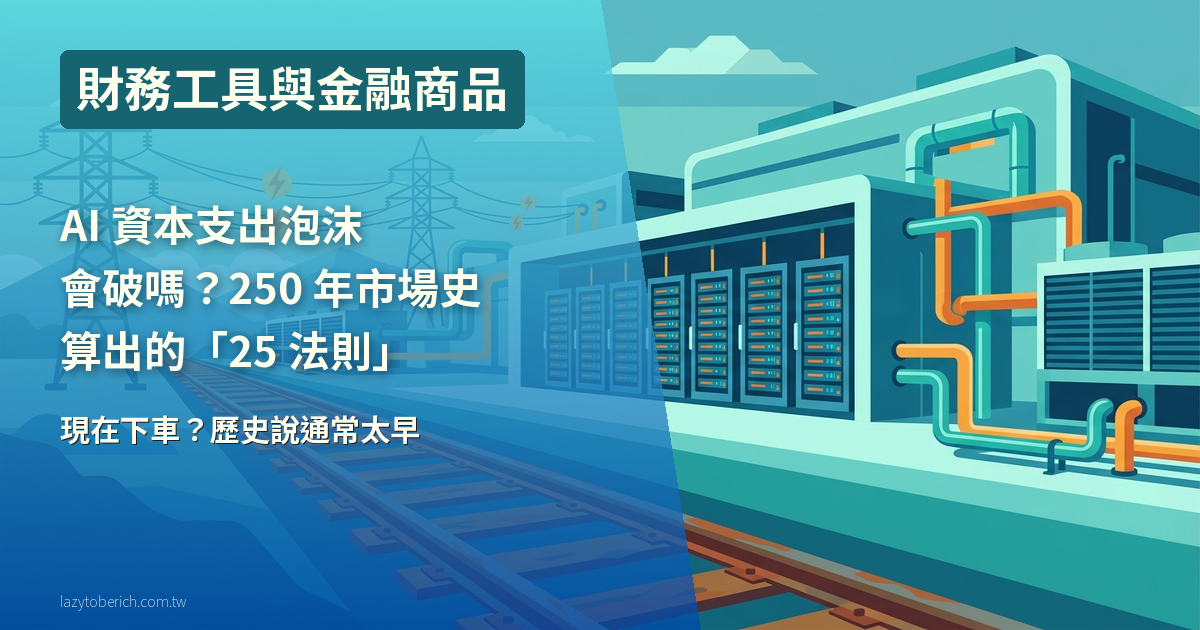
Will the AI Capex Bubble Burst? The "Rule of 25" Drawn From 250 Years of Market History
When will the AI capex bubble burst? Barron's uses 250 years of market …
2026-08-29
7 分鐘 →
Have you ever thought that the money tech companies are spending on AI now is more than what it cost to send people to the moon?
According to a Wall Street Journal report on February 7, 2026, the four major US tech giants—Microsoft, Meta, Amazon, and Alphabet (Google’s parent company)—are expected to invest a whopping $670 billion in AI infrastructure this year. This figure accounts for 2.1% of the US GDP, exceeding not only the Apollo moon landing program (0.2%) but also the construction of the Interstate Highway System from 1955 to 1970 (0.4%), and even surpassing the great railway expansion of the 1850s (2.0%).
The only thing bigger? The Louisiana Purchase of 1803 (3.0%), which doubled the size of the United States.
Let’s take a look at each company’s projected capital expenditure for 2026:
| Company | Projected Capital Expenditure | Market Cap |
|---|---|---|
| Amazon | $200 billion | $2.26 trillion |
| Alphabet | $185 billion | $3.91 trillion |
| Microsoft | $150 billion | $2.98 trillion |
| Meta | $135 billion | $1.67 trillion |
Meta’s spending is the most outrageous—capital expenditure may exceed 50% of revenue for the first time. This means that more than half of Meta’s earnings will be used to build data centers.
And Amazon announced that capital expenditure would increase by nearly 60% compared to last year, reaching $200 billion. The stock price plummeted on the news, with a single-day market value loss of $124 billion.
This money is mainly spent on the construction of data centers. The training and operation of AI models require a lot of computing power, which comes from data centers around the world. From GPU chips and cooling systems to power supply, every item is an astronomical investment.
The proportion of these companies’ capital expenditure to revenue has been rising steadily in recent years, which means they are investing more and more of their profits in the AI arms race.
If you are investing in US stocks for the long term, your ETF is likely to hold shares of these four companies, so this is closely related to you.
Investors’ reactions to this wave of AI spending are split:
This is the reality of investing—even if you spend a lot of money, the market looks at whether you can earn it back.
If you invest in ETFs like VOO, which tracks the S&P 500, these four companies account for a significant weighting. Their capital expenditure decisions directly affect the performance of your investment portfolio.
But that doesn’t mean you need to panic. Remember, the next generation’s necessities may be AI, just like the internet in the last generation. If these investments are successful, the returns will be huge.
Faced with this historic industry investment, the best strategy for the average investor is actually very simple:
The biggest difference is that the moon landing program was funded by the government, while AI investment is funded by companies themselves.
These tech companies use advertising revenue, cloud services, and subscription fees to support these astronomical expenditures. In other words, every time you search on Google, swipe on Instagram, or shop on Amazon, you are indirectly paying for AI infrastructure.
And unlike the moon landing, the goal of AI investment is not a one-time achievement, but to build a long-term business moat. Whoever has the strongest AI infrastructure will have an advantage in future competition.
Tech giants’ investment in AI has reached historic proportions, but for the average investor, the most important thing is not how big the number is, but whether your investment strategy can stand the test of time.
Whether AI is the next internet revolution or not, the principles of diversification and long-term holding will never be outdated. Instead of worrying about how much money tech giants are spending, make sure your own financial planning is solid.
🔒 免費訂閱,隨時可退訂
📩 訂閱即送 · Lead Magnet
訂閱即送 「ETF 懶人投資工具包」(VT/VOO/QQQ/0050 速查表、投資前檢查清單、定期定額紀律表)。有值得講的才寄 · 隨時退訂。